
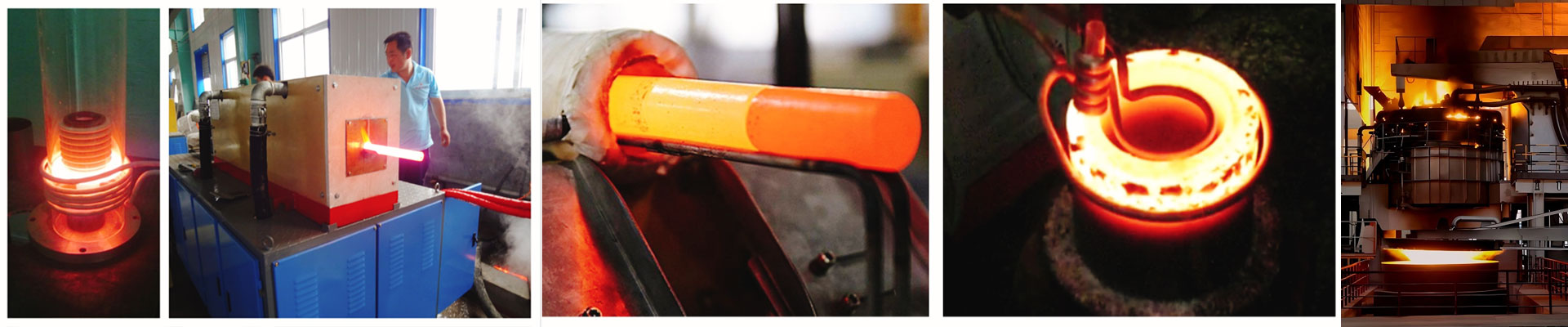
Induction Melting Furnace: How Medium Frequency Designs Handle 0.5 to 30 Ton Heats
Induction melting is the cleanest, fastest way to melt small to mid-size batches of metal. No electrodes, no combustion products, no carbon pickup. The energy goes directly into the metal through electromagnetic induction. For foundries producing 1000 to 30000 tons of castings per year, the medium frequency induction furnace is the default choice. The technology is mature, the equipment is reliable, and the process is well understood.
How Induction Melting Works
An induction furnace has a copper coil surrounding a refractory-lined crucible. AC current at 150 Hz to 10 kHz (medium frequency) flows through the coil and creates a strong alternating magnetic field inside the crucible. The magnetic field induces eddy currents in the metal charge, and the eddy currents heat the metal by Joule heating.
The skin effect concentrates the eddy currents at the surface of the metal. At 1000 Hz, the skin depth in liquid steel is about 25 mm, which means the heat is generated in the outer 25 mm of the bath. The bath then conducts the heat inward through normal thermal conduction. The stirring effect of the magnetic field circulates the bath and speeds up the temperature equalization.
For larger furnaces (above 5 tons), the natural stirring is not sufficient to keep the bath temperature uniform. A bottom-stirring coil or a gas-stirring lance is added to improve the bath homogeneity. The temperature gradient between the top and the bottom of a 10-ton bath can be 30 to 50 degrees Celsius without stirring, and 5 to 10 degrees Celsius with stirring.
Frequency Selection
The frequency is matched to the furnace size. Smaller furnaces run at higher frequencies (1 to 10 kHz for 0.5 to 2 ton furnaces), and larger furnaces run at lower frequencies (150 to 500 Hz for 5 to 30 ton furnaces). The lower frequency for larger furnaces gives deeper skin depth and more uniform heating, but it requires larger capacitors and more reactive power compensation.
MONTE INTELLIGENCE induction melting furnaces are designed with solid-state IGBT inverters at 1 to 4 kHz for small furnaces and thyristor inverters at 150 to 500 Hz for large furnaces. The power range is 250 kW to 12 MW, matching furnace sizes from 0.5 ton to 30 ton.
Crucible Design and Refractory
The crucible is the wear part of an induction furnace. The standard construction is a rammed lining of magnesia or alumina-magnesia refractory, with a working life of 300 to 1000 heats depending on the metal being melted and the operating practice.
For iron and steel, the standard refractory is 85 to 92 percent MgO with a spinel binder. The lining is rammed in place during installation, dried with electric heaters, and sintered by the first few heats. The sintered lining develops a glassy working surface that protects the bulk refractory from metal penetration.
For non-ferrous metals (copper, aluminum, brass), the standard refractory is alumina-based. The lining life is typically longer than iron and steel, with 1000 to 3000 heats typical for copper and 500 to 1500 heats for aluminum.
Crucible failures are a major operational concern. A crucible that wears through during a heat allows molten metal to contact the copper coil, with catastrophic results. The standard protection is a ground fault detection system that monitors the current path between the molten metal and the coil. A fault trips the power in milliseconds, but the damage to the coil and the surrounding structure is severe.
Operational Practices
Induction furnace operation is a craft. The most experienced operators know the sounds of the furnace: the steady hum of a good load, the harsh crackle of a bridging chunk, the deep groan of a wet charge. They watch the power factor, the line current, and the cooling water temperature continuously, and they can diagnose a developing problem before the gauges show it.
The standard operating sequence is: load charge (cold or preheated), power on at 50 to 70 percent of rated power, ramp to full power as the bath forms, hold at full power to reach the target temperature, tap. For a 5-ton iron heat, the cold charge melts in 60 to 75 minutes at 3.5 MW input, and the tap temperature is reached in 80 to 95 minutes. The power consumption is 550 to 600 kWh per ton of liquid iron.
Hot charge operation (using liquid metal from a previous heat or from a cupola) cuts the melting time to 30 to 45 minutes and the power consumption to 350 to 450 kWh per ton. Many foundries use a duplex arrangement with a coreless induction furnace for melting and a channel furnace for holding and superheating. The duplex arrangement improves the energy efficiency and the production flexibility.
Furnace Sizes and Capacities
MONTE INTELLIGENCE supplies induction melting furnaces in 0.5 to 30 ton capacity ranges, with power ratings from 250 kW to 12 MW. The most common sizes are:
0.5 to 1 ton, 250 to 500 kW: small foundries, jewelry, specialty alloys
1 to 3 ton, 500 kW to 1.5 MW: jobbing foundries, iron castings
3 to 5 ton, 1.5 to 3 MW: high-production iron and steel foundries
5 to 10 ton, 3 to 6 MW: large foundries, ductile iron production
10 to 20 ton, 6 to 10 MW: steel foundries, large iron foundries
20 to 30 ton, 10 to 12 MW: steel mill electric arc furnace replacement
The control system uses a PLC with an HMI touch screen interface. The system monitors all electrical parameters, the cooling water temperatures, the refractory status, and the operating sequence. The system also stores process recipes for different alloys.
Power Supply Technology
The power supply is the most expensive part of an induction melting furnace. Modern designs use solid-state IGBT or thyristor inverters to convert the 50/60 Hz line power to the medium frequency output. The inverter efficiency is 95 to 97 percent, and the overall electrical efficiency from line input to heat in the metal is 75 to 85 percent. IGBT inverters are standard for small to mid-size furnaces (up to 5 ton, 3 MW), and thyristor inverters are used for larger furnaces where the IGBT current ratings are limited.
Cooling Water System
The copper coil and the inverter electronics are water-cooled. The cooling water removes 15 to 25 percent of the input power, and the cooling system is critical to the furnace operation. The standard configuration is a closed-loop cooling tower with a heat exchanger to the process water. The cooling water temperature is controlled at 30 to 40 degrees Celsius at the inlet to the coil.
Cooling water quality is important. Hard water causes scale buildup in the coil, which reduces the heat transfer and eventually blocks the cooling passages. The standard water treatment is a softener plus chemical inhibitors. The cooling water is checked monthly for hardness, pH, and conductivity.
Selection Criteria for Buyers
For buyers specifying an induction melting furnace, the key questions are: what is the metal being melted, what is the production rate, what is the charge material (cold or hot), and what is the available electrical infrastructure. The furnace size and the power rating are then matched to these parameters.
MONTE INTELLIGENCE engineering can model the melting time, the power consumption, and the operating cost for a specific production profile. The output is a furnace specification with performance guarantees.
Talk to MONTE INTELLIGENCE About Induction Melting
For buyers considering a new induction melting furnace or a replacement of an existing unit, MONTE INTELLIGENCE engineering can recommend a furnace configuration that matches the metal, the production rate, and the available power supply. Visit www.cnlymonte.com/products-medium-frequency-furnace.html for product specifications. For a project discussion, email helenxu@cnlymonte.com with subject line induction melting inquiry and details on your metal, production target, and charge material.
