DC vs AC Electric Arc Furnace: A Practical Comparison for Steel Plant Operators
\nThe question isn't whether you need an electric arc furnace for steel melting — it's which topology will give your plant the best return over the next 15 to 20 years. If you're planning a greenfield mini-mill in Lagos, upgrading a scrap-fed shop in Mumbai, or expanding capacity in São Paulo, the DC-versus-AC decision ripples through your energy bill, your electrode budget, your maintenance schedule, and even your grid connection costs.
\nThis comparison draws on published operating data, conversations with plant managers across emerging markets, and the engineering experience we've accumulated at MONTE INTELLIGENCE designing and commissioning both furnace types worldwide.
\nThe Fundamental Difference — In Plain Language
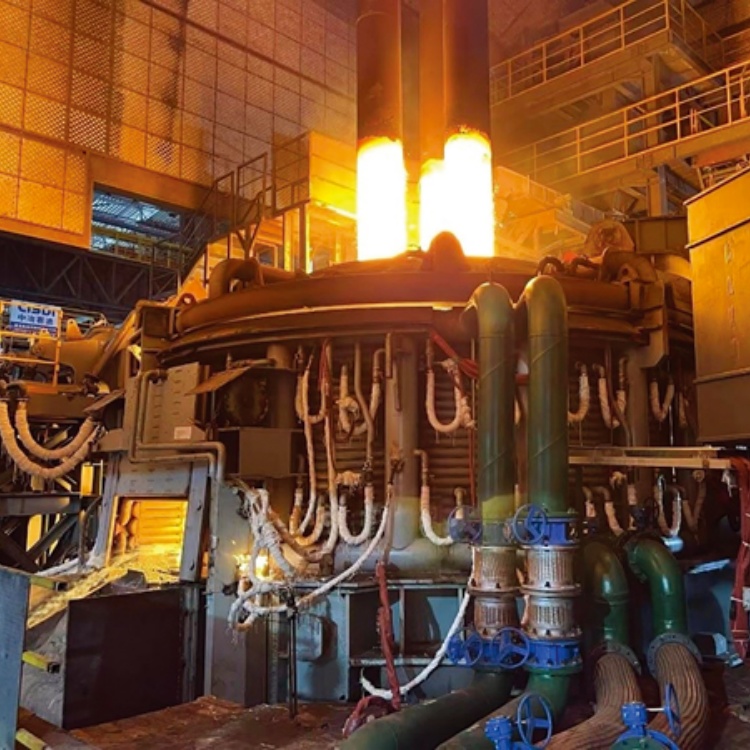
\nAn AC electric arc furnace uses three graphite electrodes, each carrying alternating current that reverses direction 50 or 60 times per second. The three arcs dance across the scrap pile, generating heat through both arc radiation and resistance heating in the melt.
\nA DC electric arc furnace uses a single top electrode (cathode) and bottom electrodes (anodes) built into the furnace hearth. Current flows in one direction only. The arc is more stable, more concentrated, and generates a strong electromagnetic stirring force in the melt.
\nEnergy Consumption: The Numbers That Matter
\nSpecific energy consumption is the metric that keeps plant managers awake:
\n\n| Metric | AC EAF | DC EAF |
|---|
\n| Electrical energy consumption | 380-450 kWh/t | 340-400 kWh/t |
\n| Electrode consumption | 2.5-4.0 kg/t | 1.2-2.0 kg/t |
\n| Tap-to-tap time (typical) | 45-60 min | 40-55 min |
\n| Flicker (Pst 99%) | 3.0-6.0 | 0.8-2.0 |
\n
\nThe DC furnace's energy advantage of roughly 5-12% comes from the single arc delivering heat more efficiently into the melt rather than heating the furnace sidewalls, and electromagnetic stirring distributing heat uniformly, reducing cold spots.
\nFor a 60-ton furnace running 50 heats per day at $0.10/kWh, that 5% edge translates to annual savings of $350,000-$550,000. Over a 15-year furnace life, you're looking at $5-8 million.
\nElectrode Costs: Where DC Really Shines
\nGraphite electrodes remain one of the most volatile cost inputs in EAF steelmaking. After the 2017-2018 electrode supply crisis sent prices above $30/kg, many operators reassessed their consumption rates.
\nAn AC furnace with three electrodes consuming 3.0 kg/t at $12/kg adds $36 per ton in electrode cost alone. A DC furnace at 1.5 kg/t adds just $18. For a plant producing 500,000 t/year, that's a $9 million annual difference.
\nGrid Impact and Flicker: Why It Matters in Developing Markets
\nIn Nigeria, grid stability is a genuine concern. In parts of Southeast Asia, utilities impose severe penalties for voltage flicker above Pst 1.0.
\nAC furnaces are notorious flicker generators. The three arcs ignite and extinguish unpredictably during bore-down and early meltdown, causing rapid voltage swings. Mitigating this requires a Static Var Compensator (SVC) — a $2-5 million capital item.
\nDC furnaces, with their inherently stable arc and built-in rectifier, produce flicker values 60-75% lower. In many cases, the flicker reduction alone eliminates the need for an SVC.
\nMaintenance: Parts, Downtime, and Skill Requirements
\nAC Furnace Advantages
\n\n- Simpler bottom: No bottom electrodes to maintain, no hearth cooling circuits.
\n- Wider spare-parts ecosystem: Three-electrode AC designs have been the industry standard for decades; parts and expertise are abundant.
\n
\nDC Furnace Advantages
\n\n- Fewer electrodes to manage: One electrode arm, one set of clamps — less mechanical complexity.
\n- Longer sidewall life: The concentrated arc reduces hot spots, extending refractory campaigns.
\n- Lower noise levels: DC arc noise is 5-10 dB lower.
\n
\nDC Furnace Challenges
\n\n- Bottom electrode maintenance: The anode pins embedded in the hearth require monitoring and periodic replacement.
\n- Higher rectifier maintenance: The thyristor rectifier is a complex component requiring skilled technicians.
\n
\nCapital Cost Comparison
\nA DC EAF package typically costs 15-25% more than an equivalent-capacity AC EAF package. However, the DC package often eliminates the need for a separate SVC ($2-5 million), narrowing the gap to 5-15% on a total-project basis.
\nWhich One Should You Choose?
\nChoose AC when:
\n\n- Your grid can handle the flicker (or you already have an SVC)
\n- Your team lacks DC-specific training
\n- You're running a smaller furnace (under 40 tons) where the energy advantage is less pronounced
\n
\nChoose DC when:
\n\n- You're building in a grid-constrained region (Nigeria, rural India, island grids)
\n- You're running a large furnace (60+ tons) where savings compound dramatically
\n- Utility flicker penalties are a concern
\n
\nThe MONTE INTELLIGENCE Approach
\nAt MONTE INTELLIGENCE, we manufacture both DC and AC electric arc furnaces because we believe the technology choice should serve the operator. Our engineering team works with you to model your specific grid conditions, scrap availability, production targets, and labor capabilities before recommending a topology.
\nEvery furnace we ship includes:
\n\n- Pre-commissioning simulation of your actual operating cycle
\n- On-site training for your operations and maintenance teams
\n- 24-month warranty with remote diagnostics capability
\n- Regional spare-parts warehousing in the Middle East, South Asia, and West Africa
\n
\nExplore our full EAF product line: Electric Arc Furnace for Steel Melting
\nFor a detailed consultation on which furnace topology fits your plant, contact helenxu@cnlymonte.com — we respond within 24 hours with preliminary technical recommendations.