
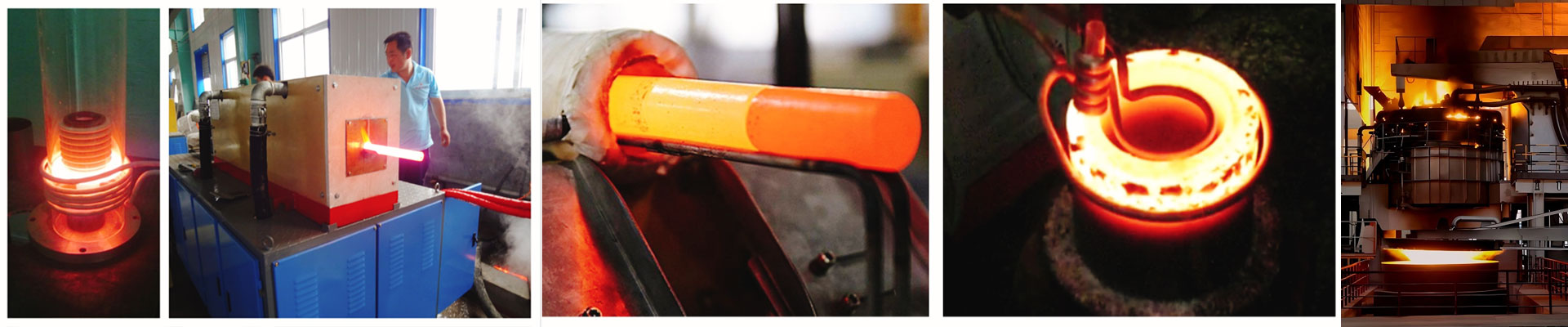
The refractory lining of a gas furnace is the barrier between a 1000°C-plus combustion environment and a steel shell that must remain below about 80°C to maintain its structural integrity and protect personnel. Ceramic fiber — also called refractory ceramic fiber (RCF) or aluminosilicate fiber — has become the dominant lining material for industrial heat treatment furnaces because of its low thermal conductivity, low heat storage, and relative ease of installation.
MONTE INTELLIGENCE specifies and installs ceramic fiber linings in our gas furnace products. This article covers the engineering decisions, installation practices, and thermal calculations that determine lining performance and service life.
Ceramic fiber is manufactured by melting a mixture of alumina (Al2O3) and silica (SiO2) in an electric arc furnace and then fiberizing the molten stream — either by blowing with compressed air or by spinning from a rotating wheel. The resulting fibers, typically 2-4 micrometers in diameter and up to 250 mm long, are formed into blankets, boards, or vacuum-formed shapes. The fiber chemistry determines the maximum service temperature: standard fibers (45-50% Al2O3, 50-55% SiO2) are rated for 1260°C; high-alumina fibers (55-60% Al2O3) for 1400°C; and zirconia-containing fibers for 1430°C.
Ceramic fiber blanket is the raw material form — a flexible, needle-punched mat of fibers, typically supplied in rolls 7.2 meters long by 0.6 meters wide, in thicknesses from 13 mm to 50 mm, with densities from 64 to 128 kg/m3. The blanket is the lowest-cost form of ceramic fiber insulation. It is installed in multiple layers to build up the required total thickness, with the layers staggered so that the joints between adjacent pieces do not line up — this prevents straight-through gaps that would allow heat to radiate directly to the shell.
Ceramic fiber modules are pre-assembled blocks of folded blanket, compressed to higher density (typically 160-220 kg/m3) and held in compression by a metal frame or by banding straps that are cut after installation. When the straps are cut, the compressed blanket expands to fill the module-to-module joints, creating a tight seal without the through-joints that plague layered blanket installations. Modules are attached to the steel shell using stainless steel anchors — typically 304 or 310 stainless — that are stud-welded to the shell in a grid pattern matching the module dimensions, usually 300 mm × 300 mm.
The lining design starts with a heat flow calculation. The heat flow through a plane wall is: Q = k × A × (T_hot - T_cold) / t, where k is the thermal conductivity (W/m·K), A is the area, T_hot and T_cold are the hot and cold face temperatures, and t is the thickness. For ceramic fiber at 1000°C mean temperature, k is approximately 0.15-0.25 W/m·K depending on density. For a 300 mm thick lining with T_hot = 1000°C and T_cold = 80°C, the heat flux is about 0.2 × 920 / 0.3 ≈ 613 W/m2 — which is the design heat loss that the furnace energy balance must account for.
The lining typically uses multiple layers of different materials to balance cost and performance. The hot face layer — exposed to the highest temperature — uses the highest-grade fiber appropriate to the furnace maximum temperature. Behind the hot face, a lower-cost backup layer of lower-temperature fiber or mineral wool can be used because the hot face layer drops the temperature significantly. The interface temperature between layers is calculated from the thermal resistances: if the hot face is 200 mm of 1260°C fiber (k = 0.18) and the backup is 100 mm of mineral wool (k = 0.08), the interface temperature is calculated as T_interface = T_hot - Q × (t_hotface / k_hotface). The backup layer temperature rating must exceed this interface temperature.
Attachment system design must account for thermal expansion. The steel shell expands when heated — about 1.2 mm per meter per 100°C temperature rise. The ceramic fiber lining expands much less — about 0.5 mm per meter per 100°C. The difference in expansion between the shell and the lining creates shear stress at the attachment points. The anchor system must accommodate this differential movement without tearing the fiber modules. Slotted anchor holes or flexible anchor designs are used for this purpose.
Installation quality determines whether the calculated thermal performance is actually achieved in service. Gaps between modules — from poor fit-up, from damage during installation, from anchor failure — are the most common cause of hot spots on the furnace shell. A 3 mm gap over one square meter of lining can increase the local heat loss by a factor of 5-10. Quality control during installation includes checking module fit-up (maximum allowable gap typically 2-3 mm), verifying anchor weld integrity (pull-test a sample of anchors), and inspecting for compressed or damaged modules that will not expand properly when heated.
Lining maintenance during furnace operation consists of regular visual inspection of the shell exterior for hot spots — indicated by paint discoloration, surface temperatures above 80°C measured with an infrared thermometer, or visible glowing at night. Hot spots should be mapped and monitored. A hot spot that is stable at 100-120°C may be acceptable for continued operation until the next scheduled shutdown. A hot spot that is increasing in temperature or that exceeds 150°C should be investigated and repaired at the next opportunity.
MONTE INTELLIGENCE furnace linings are designed for a service life of 5-8 years under normal operating conditions. We provide installation supervision, thermal calculations, and lining inspection services.
For ceramic fiber lining design or relining of your existing furnace, contact helenxu@cnlymonte.com.
