
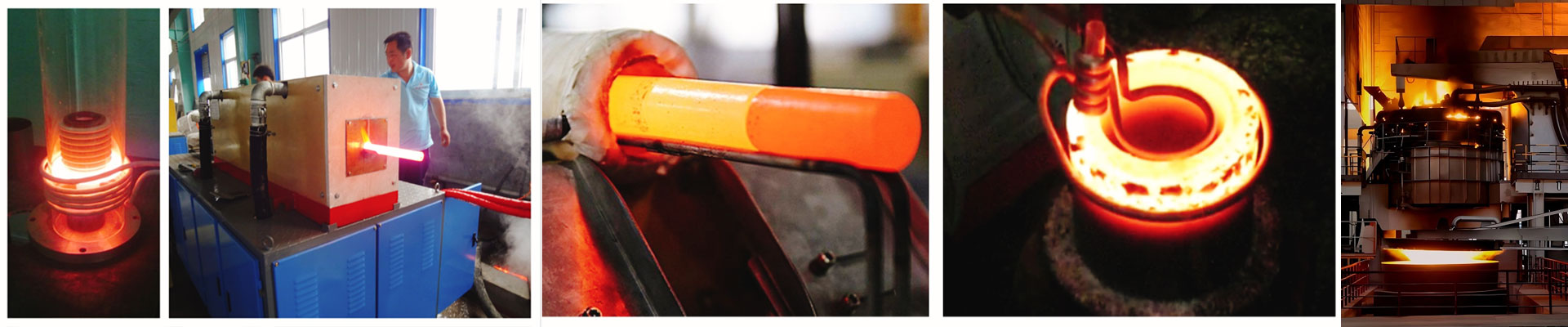
Every electric arc furnace operator who has dealt with a roof ring failure knows the cost. When the roof ring goes down, the entire heat is lost. Not just the heat — the production schedule, the downstream caster, the rolling mill. Everything stops.
At MONTE INTELLIGENCE, we have supplied EAF roof rings to steel plants across Asia, the Middle East, and Africa. Through those projects, we have learned what works and what fails. This article shares that field experience.
The EAF roof ring sits at the intersection of three brutal environments. From below, it faces direct radiation from the arc — temperatures can spike past 1700°C at the hot spots. From the side, it carries the mechanical load of the electrodes, which weigh several tons each and vibrate during melting. From within, it channels cooling water through passages that must stay leak-free under thermal cycling that would crack ordinary steel.
Material selection starts with the base steel. Most roof rings use AISI 304 or 316 stainless for the water-cooled panels. The choice between 304 and 316 comes down to one question: how much chloride is in your cooling water. If you run a closed-loop system with treated water, 304 works fine. If you use once-through cooling from a river or well with variable water quality, the chloride pitting resistance of 316 — with its 2-3% molybdenum content — pays for itself within the first year. We have seen 304 roof rings develop pinhole leaks within six months in brackish cooling water, while 316 rings in the same plant lasted three years.
The refractory delta — the triangular section between the three electrode ports — is where most roof ring failures begin. This area sees the most intense radiant heat and the highest thermal gradient between the water-cooled steel and the refractory surface. The conventional approach uses high-alumina brick (85-90% Al2O3), which gives good service life under normal operating conditions. However, when the furnace runs long arc practice or when the scrap mix includes high percentages of DRI with its associated foamy slag carryover, the delta refractory takes a beating.
For those conditions, we recommend magnesia-carbon brick for the delta area. MgO-C brick combines the high refractoriness of magnesia (melting point 2800°C) with the slag resistance of carbon. The carbon also provides thermal conductivity that helps spread the heat load more evenly, reducing hot spot temperatures by 50-80°C compared to high-alumina alone. The trade-off is cost — MgO-C brick runs about 40% more expensive than high-alumina — but the extended campaign life typically delivers a 2:1 return on that extra investment.
Water cooling design separates the adequate roof rings from the excellent ones. The key parameter is water velocity through the cooling passages. Below 1.5 meters per second, you risk nucleate boiling at the hot spots, which creates steam pockets that insulate the steel from the cooling water. Once steam forms, the steel temperature can spike by 200°C in seconds, leading to thermal fatigue cracking. We design for a minimum water velocity of 2.0 m/s in all roof ring passages, with higher velocities of 2.5-3.0 m/s at the electrode port areas where the heat flux is highest.
Flow distribution matters just as much as total flow. A roof ring with uneven cooling develops thermal gradients across its structure. Those gradients create differential thermal expansion, which generates mechanical stress at the welded joints — exactly where you do not want stress. We use computational fluid dynamics (CFD) modeling to verify that every water passage receives its design flow before the ring goes into production.
The delta configuration — meaning how the electrode ports are arranged on the roof — affects both electrical performance and refractory life. The standard delta has the three electrodes at the vertices of an equilateral triangle. The pitch circle diameter (PCD), which is the diameter of the circle passing through the three electrode centers, is a critical design parameter. Too small a PCD and the arcs heat the sidewalls excessively. Too large a PCD and the cold spots between electrodes create unmelted scrap bridges.
For a typical 50-tonne EAF, the PCD ranges from 700 to 900 mm depending on the transformer power. Higher power means you can run a larger PCD because the longer arcs provide more radiant heat coverage. The roof ring must accommodate the selected PCD while maintaining adequate refractory thickness between the electrode ports and the outer shell. We typically specify a minimum refractory thickness of 150 mm between any electrode port and the roof ring inner diameter.
Electrode port seals deserve attention. Every gap around the electrode port is a path for hot gas to escape and for air to enter. Air ingress is particularly problematic because it burns carbon from the electrodes and adds nitrogen to the steel. A well-designed roof ring includes mechanical seals — either graphite rings or spring-loaded stainless steel rings — that maintain contact with the electrode as it moves up and down during regulation. The seal must allow about 5 mm of radial clearance for electrode movement while maintaining gas tightness to within 2-3% leakage.
Installation and alignment are where field practice separates from engineering theory. A roof ring that is perfectly designed on paper can fail within weeks if it is installed with even a 3 mm misalignment. The ring must sit perfectly level on the furnace shell. Any tilt creates uneven loading on the refractory and uneven water flow distribution. We always ship our roof rings with a machined reference surface and provide alignment pins that mate with the furnace shell flange. Field crews should check levelness with a precision spirit level (0.02 mm/m accuracy) at four points around the ring before tightening the mounting bolts.
Maintenance intervals depend on operating practice. Under normal conditions — 20 heats per day, typical scrap mix — inspect the refractory delta after every 200 heats. Look for erosion depth exceeding 50% of the original refractory thickness, cracking wider than 3 mm, and spalling at the electrode port edges. The water-cooled panels should be pressure-tested at 1.5 times operating pressure every 500 heats. Any panel that shows a pressure drop of more than 5% over 15 minutes should be removed and repaired.
MONTE INTELLIGENCE roof rings are designed for a minimum campaign life of 2000 heats under normal operating conditions. Actual service life in the field ranges from 1800 to 3500 heats depending on the application. The difference between the low end and the high end comes down to the operating practices described above — water quality, refractory selection, and alignment discipline.
If you are planning an EAF roof ring replacement or a new furnace project, contact our engineering team at helenxu@cnlymonte.com. We can provide a detailed technical proposal based on your specific furnace configuration, scrap mix, and production targets.
