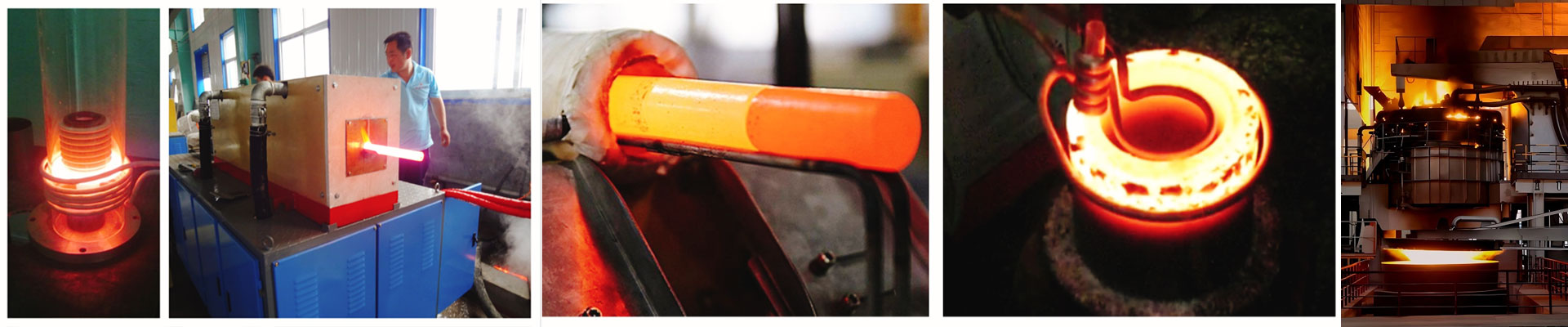
Induction heating equipment for forging delivers precision billet heating to 1100°C to 1250°C in seconds. Surface oxidation drops below 0.5% of workpiece weight versus 2% to 3% in gas-fired slot furnaces. Forge shops using MONTE INTELLIGENCE induction heating systems achieve 30% to 50% productivity improvements through faster heat-up and reduced material waste.
[Image 3: Steel billets heated by medium frequency induction heating equipment exiting coil for hot forging. Alt: Industrial induction heating equipment for steel billet heating in forging operations]
Medium frequency induction heating performs surface hardening, tempering, annealing, and stress relieving with ±5°C precision. Induction hardening equipment processes gears, bearing races, shafts, and cam lobes to case depths of 0.5 mm to 10 mm. Induction heat treatment systems achieve throughput of 100 to 1,000 pieces per hour, reducing energy consumption by 40% to 60% versus conventional batch furnaces.
Induction brazing equipment delivers localized clean heating for automotive, aerospace, HVAC, and electrical manufacturing. Cycle times of 5 to 60 seconds per joint outperform torch and furnace brazing methods significantly. Induction brazing eliminates open flames and combustion byproducts, creating safer production environments with consistent joint quality performance.
[Image 4: IGBT-based medium frequency induction heating power supply with digital HMI interface at MONTE INTELLIGENCE. Alt: IGBT medium frequency induction furnace power supply and digital control panel]
Medium frequency induction heating equipment delivers five core benefits compared to gas-fired and resistance heating. Process time decreases by 50% to 80% because heat generates directly within metal rather than transferring through furnace atmospheres. Temperature control precision reaches ±5°C, essential for aerospace alloys and medical-grade metals requiring narrow processing windows.
Energy efficiency achieves 70% to 80% overall system efficiency versus 20% to 35% for gas furnaces after flue and radiant losses. Induction heating eliminates combustion emissions entirely, supporting corporate ESG goals and carbon reduction mandates. Equipment footprint occupies 60% less floor space than equivalent-capacity fuel-fired furnaces.
MONTE INTELLIGENCE induction furnaces feature PLC controls with HMI touchscreen interfaces for recipe-based operation and real-time power monitoring. Remote diagnostics enable MONTE INTELLIGENCE engineers to troubleshoot induction heating equipment via secure internet connections, minimizing customer production downtime.
[Image 5: MONTE INTELLIGENCE quality team calibrating medium frequency induction heating furnace before shipment. Alt: Quality inspection of medium frequency induction heating furnace at MONTE INTELLIGENCE factory]
Buyers evaluating medium frequency induction heating equipment must assess seven key parameters. Power rating (15 kW to 5,000 kW) determines heating speed and workpiece capacity. Frequency selection (1,000 Hz to 8,000 Hz) controls heating depth for workpiece diameters of 15 mm to 150 mm. Coil design must match specific workpiece geometry for optimal coupling efficiency.
Cooling system capacity handles 15% to 25% of input power as heat rejection. Duty cycle ratings confirm continuous or intermittent operation suitability. Auxiliary systems include material handling automation, quenching stations, and temperature monitoring. After-sales support matters critically because induction heating equipment requires periodic IGBT replacement, coil refurbishment, and cooling maintenance.
MONTE INTELLIGENCE provides spare parts inventory, on-site commissioning, operator training, and 24/7 technical support for all induction heating installations. Visit the Induction Heating Machine product page for complete equipment specifications.
The global medium frequency induction heating market grows at 5% to 7% annually, powered by automotive electrification and renewable energy manufacturing. Electric vehicle production uses induction heating for motor components, battery tab welding, and lightweight alloy processing. Wind and solar manufacturing employs induction technology for bearing heat treatment and structural brazing.
Industry 4.0 integration connects induction heating systems to factory MES and ERP platforms for predictive maintenance and energy analytics. Environmental regulations across EU, North America, and Asia mandate industrial carbon emission reductions. Medium frequency induction heating equipment enables manufacturers to eliminate natural gas consumption, directly advancing corporate decarbonization targets.
MONTE INTELLIGENCE delivers engineered-to-order medium frequency induction heating solutions with over 15 years of manufacturing expertise. Engineering teams analyze each application before recommending frequency, power, coil design, and automation configurations. MONTE INTELLIGENCE induction furnaces operate reliably in steel mills across India, forging plants in Southeast Asia, foundries in the Middle East, and heat treatment facilities in Africa.
Every induction heating system undergoes full-power factory acceptance testing with temperature uniformity verification before shipment. Customers receive electrical schematics, PLC backups, maintenance schedules, and spare parts catalogs for long-term equipment management.
Request Your Free Induction Heating Equipment Technical Evaluation →
Free Download: "Industrial Induction Heating System Selection Checklist" — a 15-point assessment tool for power requirements, frequency selection, and coil specifications. Email helenxu@cnlymonte.com with subject "Induction Heating Checklist" for the PDF within one business day.
Helen Xu is Senior Technical Sales Engineer at MONTE INTELLIGENCE, specializing in industrial induction heating equipment and electric furnace solutions. With over a decade of application engineering experience, Helen Xu supports equipment selection, technical consultation, and after-sales service for global B2B markets across Asia, the Middle East, Africa, and Southeast Asia.
">