
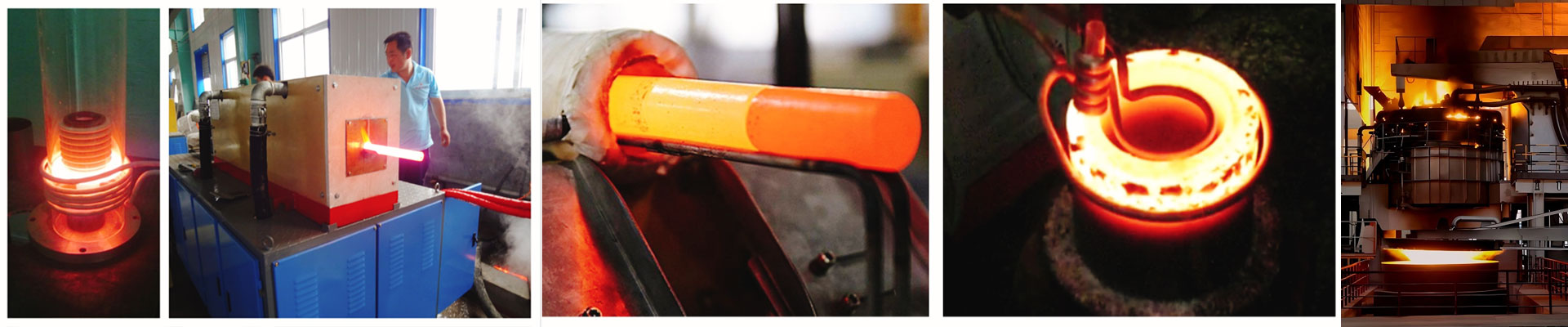
Induction Heating Physics: Skin Effect, Penetration Depth, and Coupling Efficiency
Induction heating looks like magic from the outside: a metal bar enters a coil, gets hot in seconds, and comes out the other side at a precise temperature. Inside, the physics is well understood, and the design equations are accurate enough to design a heater without ever building a prototype. Every induction heating decision - frequency, coil geometry, power density - traces back to three fundamental concepts: skin effect, penetration depth, and coupling efficiency. Get those right, and the rest is detail.
Skin Effect and Penetration Depth
When AC current flows through a conductor, the current density is not uniform across the cross-section. The current concentrates at the surface, and the density decreases exponentially with depth. This is the skin effect.
The depth at which the current density drops to 37 percent (1/e) of the surface value is the penetration depth. The penetration depth depends on the frequency, the permeability, and the resistivity of the material. The formula is:
delta = 503 x sqrt(rho / (mu x f))
where delta is the penetration depth in meters, rho is the resistivity in ohm-meters, mu is the relative permeability, and f is the frequency in Hz.
For copper at room temperature at 10 kHz, the penetration depth is about 0.65 mm. For steel at 800 degrees Celsius (above the Curie temperature, where mu drops to 1) at 10 kHz, the penetration depth is about 5 mm. The penetration depth is the key parameter in induction heating: it determines how deep the heat is generated, and it determines the minimum frequency needed to heat a given bar size efficiently.
The Coupling Problem
Induction heating is a coupling problem between the coil and the workpiece. The coil produces a magnetic field, the magnetic field induces eddy currents in the workpiece, and the eddy currents produce a counter-magnetic field that partially cancels the original. The result is that only a fraction of the magnetic flux generated by the coil actually reaches the workpiece.
The coupling efficiency is the ratio of the power delivered to the workpiece to the power delivered to the coil. A well-designed induction heater has a coupling efficiency of 80 to 95 percent. A poorly designed heater (large air gap, wrong frequency, wrong coil geometry) might have 30 to 50 percent coupling efficiency, and the rest of the power is lost in the coil, the cabling, and the cooling water.
The coupling depends on the frequency, the workpiece size, the air gap, and the coil geometry. Higher frequency gives better coupling for small workpieces, lower frequency gives better coupling for large workpieces. MONTE INTELLIGENCE engineers use FEA simulation to optimize the coil geometry for each application, and the simulation results are validated against the test bench before the heater is released to production.
Curie Temperature and Magnetic Transition
Steel is ferromagnetic below the Curie temperature (about 770 degrees Celsius) and paramagnetic above it. The permeability drops by a factor of 5 to 10 when the steel passes through the Curie point, and the penetration depth increases by a factor of 2 to 3.
The implication: an induction heater that runs at the right frequency for cold steel may be under-coupled when the steel is hot. A frequency that is too high for cold steel gives uneven heating in the hot zone. The standard solution is to use a dual-frequency design or a frequency-converter design that adjusts the frequency as the workpiece temperature changes.
For through-heating of large steel billets (above 100 mm diameter), the frequency is typically 50 to 200 Hz, and the dual-frequency design is rarely needed. For surface hardening of small parts (below 50 mm diameter), the frequency is 10 to 100 kHz, and the dual-frequency design is common to handle the Curie transition.
Power Density and Heating Rate
The power density (kW per square cm of workpiece surface) is the key parameter for the heating rate. A surface hardening application typically runs at 1 to 5 kW per square cm, and the heating rate is 100 to 500 degrees Celsius per second. A through-heating application runs at 0.1 to 0.5 kW per square cm, and the heating rate is 1 to 10 degrees Celsius per second.
High power density gives fast heating but limited depth. Low power density gives slower heating but more uniform temperature. The choice depends on the application: surface hardening wants high power density, through-heating wants low power density.
Coil Geometry
The coil geometry is matched to the workpiece. For bar heating, the coil is a helical winding around the bar. For surface hardening of flat parts, the coil is a pancake-style inductor that sits above the part. For complex geometries (gears, camshafts, crankshafts), the coil is a shaped inductor that matches the part profile.
The coil is made from copper tube, with the cooling water flowing through the tube center. The copper is typically rectangular cross-section (10 x 10 mm to 20 x 20 mm) for high-power applications, and round cross-section (6 to 10 mm diameter) for low-power applications. The coil is wound on a former, and the assembly is mounted in a frame that positions the coil relative to the workpiece.
Quench Integration
For surface hardening, the induction heater is followed by an integrated quench. The quench is typically a water spray or a polymer solution, with the quench timing controlled by the heater control system. The quench ring is mounted on the heater frame, and the part passes through the heater and the quench in a single linear or rotary motion.
The quench design is critical to the part quality. Insufficient quench gives soft spots; excessive quench gives cracking. The quench flow rate, the quench temperature, and the quench timing are all set by the process recipe, and the recipe is stored in the heater control system for each part number.
Frequency Selection in Practice
The standard frequency ranges for induction heating are:
1 to 10 kHz: through-heating of large billets, forging pre-heating
10 to 100 kHz: surface hardening of small to mid-size parts
100 kHz to 1 MHz: surface hardening of small parts, brazing
Above 1 MHz: specialized applications, laboratory use
MONTE INTELLIGENCE induction heaters cover the 1 kHz to 100 kHz range, which is the industrial workhorse for surface hardening and through-heating. The heaters are available in power ratings from 50 kW to 2 MW, with a range of standard coil sizes and geometries.
Total System Efficiency
The total system efficiency of an induction heater is the ratio of the heat delivered to the workpiece to the electrical power drawn from the line. A well-designed system has 70 to 85 percent total efficiency. The losses are: inverter (3 to 5 percent), coil and cabling (5 to 10 percent), cooling water (5 to 10 percent), and radiation and convection from the workpiece (2 to 5 percent).
The total efficiency of an induction heater is 30 to 50 percent higher than a gas-fired furnace for through-heating, and 50 to 100 percent higher for surface hardening. The energy savings are significant, and the total cost of ownership is lower in most markets.
Talk to MONTE INTELLIGENCE About Induction Heating
For buyers evaluating induction heating equipment, MONTE INTELLIGENCE engineering can review the application requirements and recommend a frequency, power rating, and coil geometry. Visit www.cnlymonte.com/products-medium-frequency-furnace.html for product specifications. For a project discussion, email helenxu@cnlymonte.com with subject line induction heating physics and details on your part geometry, process recipe, and throughput target.
