
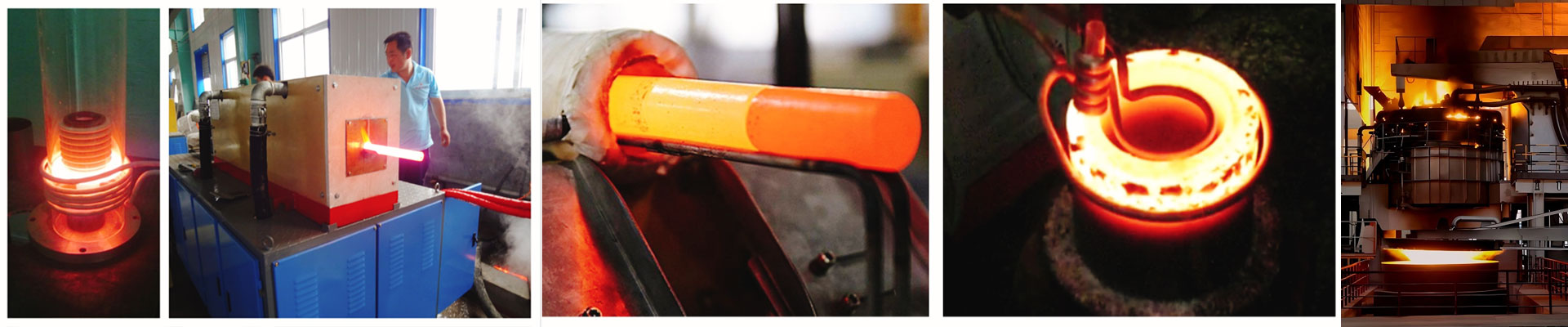
Induction Furnace Crucible Selection: Clay-Graphite, Silicon Carbide, and Alumina for Different Alloys
The crucible is the consumable that determines how long an induction furnace runs between rebuilds. Get the crucible wrong and you are relining the furnace every 50 heats instead of every 500. Get it right and the line runs for months. The right crucible depends on the alloy being melted, the furnace size, the power input, and the operator practice. There is no universal best.
Here is how the crucible decision actually gets made.
Start with the alloy.
Iron and steel melt at 1150 to 1600 degrees C depending on the carbon content and the alloy additions. The crucible has to handle the peak temperature plus a safety margin. The working temperature of the crucible material has to exceed the peak melt temperature by 100 to 200 degrees C.
For iron and steel, the standard crucible is clay-graphite (also called "clay bonded graphite" or "isostatic pressed clay graphite"). The clay-graphite crucible is a mix of graphite (typically 30 to 50 percent) and refractory clay (typically 50 to 70 percent), pressed or rammed into shape and fired. The graphite gives the crucible thermal shock resistance and lubricity. The clay gives the crucible strength and erosion resistance.
A typical clay-graphite crucible for a 1-ton induction furnace has a wall thickness of 50 to 80 mm, a height of 800 to 1000 mm, and an outer diameter of 600 to 800 mm. The crucible sits inside a water-cooled copper coil, with a backup refractory layer (typically 10 to 30 mm of dry silica sand or ceramic fiber) between the crucible and the coil.
The clay-graphite crucible has good thermal shock resistance - it can go from cold to molten steel without cracking, which is critical for induction furnace operation where the crucible heats and cools every shift. The downside is that the clay-graphite is consumed by the melt - the iron oxide in the slag attacks the silica in the clay, the carbon in the graphite dissolves into the melt, and the crucible wall thins over time. A typical clay-graphite crucible lasts 100 to 300 heats in a steel-melting induction furnace, depending on the size, the power, and the slag practice.
For higher-temperature alloys and longer life, silicon carbide (SiC) crucibles are an option. The SiC crucible is more erosion-resistant than clay-graphite, particularly in aggressive slags. The downside is that SiC is more expensive and more brittle - it does not handle thermal shock as well as clay-graphite. SiC crucibles are common in copper and brass melting, where the operating temperature is lower and the thermal shock is less severe.
For aluminum and zinc melting, the standard crucible material is alumina (Al2O3) or a high-alumina refractory. The working temperature of aluminum is 660 to 750 degrees C, well below the limit of most refractory materials. The challenge is that molten aluminum is highly reactive - it attacks silica-based refractories by reducing the silica to silicon, which dissolves into the melt. The result is a high-silicon aluminum alloy, an eroded crucible, and a contaminated melt.
Alumina crucibles resist the aluminum attack because alumina is thermodynamically stable in contact with molten aluminum. The downside is that alumina is more expensive and more brittle than clay-graphite. A typical alumina crucible for aluminum melting lasts 500 to 2000 heats, much longer than clay-graphite in the same service.
For copper and brass melting, silicon carbide crucibles are the standard. SiC handles the 1000 to 1300 degrees C copper temperature, resists the copper oxide slag, and has good thermal shock resistance for the induction heating cycle. A SiC crucible for copper melting lasts 300 to 1000 heats.
For precious metals (gold, silver, platinum), the standard crucible is fused silica or high-purity alumina. The crucible has to be chemically inert (no contamination of the melt) and thermally stable. The cost is high, but the volume is low.
The crucible shape and size matter too.
Induction furnace crucibles are typically cylindrical, with a flat or rounded bottom. The diameter and the height are determined by the furnace size and the melt capacity. A 500 kg furnace has a crucible of about 400 mm diameter and 600 mm height. A 5-ton furnace has a crucible of about 900 mm diameter and 1500 mm height. A 20-ton furnace has a crucible of about 1500 mm diameter and 2500 mm height.
The wall thickness scales with the crucible size - larger crucibles need thicker walls to handle the mechanical load of the melt. A small crucible might have a 30 mm wall, while a large crucible has a 100 mm wall.
The crucible bottom design is a critical detail. A flat bottom is easier to manufacture but concentrates thermal stress at the corners. A rounded bottom distributes the stress more evenly and is preferred for large crucibles and for high-power operation. Most large induction furnace crucibles have a hemispherical or a conical bottom.
The crucible installation is a 4 to 8 hour job for a medium furnace.
The installation starts with cleaning the coil and the backup refractory. Any leftover metal, slag, or debris from the previous crucible has to be removed. The new backup refractory is installed - typically a layer of dry silica sand rammed into place, or a preformed ceramic fiberboard.
The crucible is then lowered into the furnace. The alignment has to be concentric with the coil - a misaligned crucible creates uneven electromagnetic coupling, hot spots, and premature failure. The crucible is centered using a fixture, then the gap between the crucible and the backup is filled with sand or ceramic fiber.
The new crucible is sintered (baked out) before the first melt. The sintering cycle ramps the temperature slowly to 800 to 1000 degrees C over 4 to 8 hours, drives off any moisture, and stabilizes the crucible. After sintering, the first melt is loaded, and the crucible is in service.
A new crucible needs careful operation in the first 10 to 20 heats. The thermal shock of a cold charge hitting a hot crucible can crack even a well-installed crucible. Operators typically load the first charge at 50 to 70 percent of the crucible capacity, melt it, and pour it before loading the first full charge. This "seasoning" process stabilizes the crucible and extends its life.
Crucible failure modes are the operational reality.
The most common failure mode is wall thinning. The slag and the melt attack the crucible wall, the wall gets thinner, and eventually the wall fails. The operator sees this as a gradual increase in melt temperature instability, as the crucible wall no longer insulates the melt from the coil cooling. The fix is to reline the furnace with a new crucible.
The second most common failure mode is cracking. A thermal shock (cold charge, power interruption, or slag infiltration) creates a crack in the crucible wall. The crack can be small (a hairline that does not penetrate) or large (a through-crack that lets the melt leak into the coil). A small crack is sometimes manageable for a few heats, but a large crack is an emergency - tilt the furnace, pour the melt, and shut down.
The third failure mode is metal penetration. The molten metal wicks into the pores of the crucible, creating a metallic bridge between the melt and the coil. The result is a current path through the crucible, the crucible heats unevenly, and the failure accelerates. Metal penetration is usually caused by a poor backup refractory, an under-sintered crucible, or excessive power during the first heats.
Author: MONTE INTELLIGENCE induction furnace engineering team. For crucible selection and life cycle studies, contact helenxu@cnlymonte.com.
