
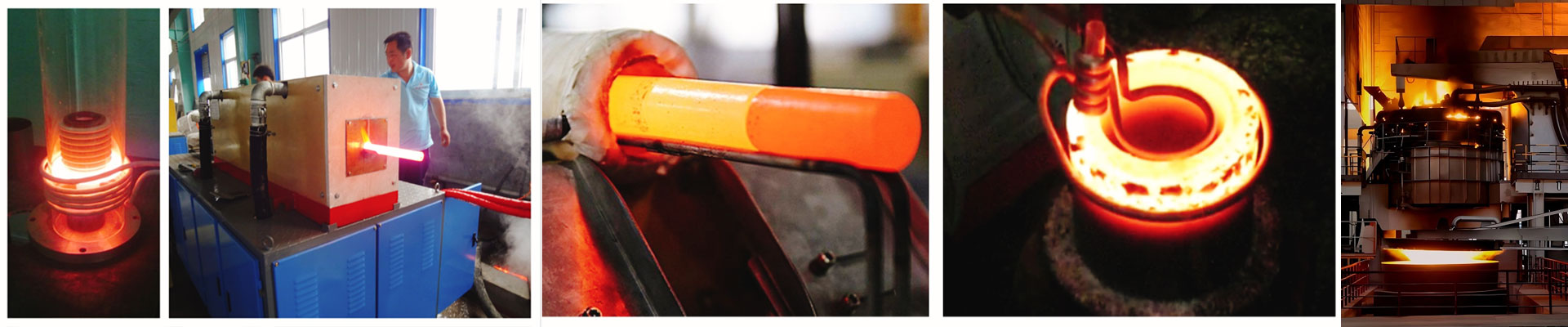
Gas Furnace Process Atmospheres: Stress Relieving, Normalizing, Annealing, and Bright Hardening
Gas-fired furnaces handle the majority of large-scale heat treatment processes in the metalworking industry. Stress relieving of welded structures, normalizing of forgings, annealing of castings, and bright hardening of small parts are all common applications, and the furnace design and the atmosphere control differ for each. Let me walk through the major process applications, the typical furnace design, and the atmosphere requirements.
Stress Relieving
Stress relieving is the most common gas furnace application. The process heats a welded or machined component to 550 to 700 degrees Celsius (depending on the steel grade), holds for a time proportional to the section thickness, and cools slowly. The purpose is to relieve the residual stresses from welding, machining, or cold work, without significantly altering the microstructure.
The standard furnace is a bogie hearth or a top-hat furnace, with gas-fired radiant tubes or direct-fired burners. The atmosphere is typically air (for carbon steel) or a slightly oxidizing atmosphere. The cycle time is 12 to 24 hours per load, depending on the part size and the section thickness.
The temperature uniformity requirement is plus or minus 10 degrees Celsius across the workload, with a 3 to 5 zone control system. The heating rate is controlled at 100 to 150 degrees Celsius per hour to avoid thermal stress cracking on thick sections.
MONTE INTELLIGENCE supplies bogie hearth and top-hat furnaces for stress relieving applications across the pressure vessel, wind tower, shipbuilding, and heavy machinery industries. The largest installation handles 200-ton loads in a 6 m wide x 8 m high x 30 m long chamber.
Normalizing
Normalizing heats a forged or rolled component to 850 to 950 degrees Celsius, holds for a time proportional to the section thickness, and cools in still air. The purpose is to refine the grain structure, improve the homogeneity, and produce consistent mechanical properties.
The standard furnace is a bogie hearth furnace, with gas-fired burners and recuperative heat recovery. The atmosphere is typically air or a slightly oxidizing atmosphere. The cycle time is 18 to 36 hours per load, depending on the part size and the section thickness.
The cooling rate is critical. The parts are typically cooled in still air on the bogie after the soaking period, and the bogie is rolled out of the furnace to a cooling area. The cooling rate is 50 to 100 degrees Celsius per hour, depending on the section thickness.
MONTE INTELLIGENCE supplies bogie hearth furnaces for normalizing applications to the forging and casting industries. The furnaces are designed for 10 to 200 ton loads, with 3 to 5 zone control and plus or minus 5 to 10 degrees Celsius uniformity.
Annealing
Annealing is a softer heat treatment that heats a component to 700 to 900 degrees Celsius, holds for a long time, and cools slowly in the furnace. The purpose is to soften the material, improve the ductility, and relieve internal stresses. Annealing is common for castings, cold-rolled steel, and copper alloys.
The standard furnace is a bogie hearth, top-hat, or car-bottom furnace, with gas-fired burners. The atmosphere is typically air for carbon steel, and a protective atmosphere (nitrogen or argon) for stainless steel and tool steel. The cycle time is 24 to 48 hours per load, depending on the part size and the cooling rate.
Bright Hardening
Bright hardening is a hardening process that produces a clean, oxide-free surface. The process heats a steel component to the austenitizing temperature (840 to 880 degrees Celsius, depending on the grade), holds for a time proportional to the section, and quenches in oil or polymer. The atmosphere is critical: it must be a controlled protective atmosphere that prevents oxidation and decarburization.
The standard furnace is a continuous mesh belt furnace or a shaker hearth furnace, with gas-fired radiant tubes. The atmosphere is typically endothermic gas with a controlled carbon potential, or a nitrogen-methanol atmosphere for lower volume production. The atmosphere consumption is 5 to 15 cubic meters per hour on a typical mesh belt furnace.
The quench is integrated with the furnace. The parts exit the heating chamber and enter the quench chamber within seconds. The quench is oil for high-hardenability steels and polymer for low-hardenability steels. The quench temperature and agitation are controlled to deliver the required hardness without cracking.
MONTE INTELLIGENCE supplies mesh belt furnaces for bright hardening of fasteners, small gears, and springs. The furnaces use radiant tube heating with endothermic gas atmosphere, and they integrate the quench and the wash in a single continuous line.
Brazing
Brazing joins two metal parts using a filler metal that melts above 450 degrees Celsius but below the melting point of the base metals. Gas-fired furnaces are commonly used for brazing of copper, brass, and steel assemblies.
The standard furnace is a mesh belt, a pit, or a bell furnace, depending on the part geometry. The atmosphere is typically nitrogen-hydrogen for copper brazing, nitrogen with a fluorine-bearing addition for aluminum brazing, and air for silver brazing (with a flux coating). The cycle time is 30 to 90 minutes per load, depending on the part size and the braze alloy.
MONTE INTELLIGENCE supplies brazing furnaces for automotive heat exchangers, HVAC components, and tool joints. The furnaces use precise atmosphere control and temperature uniformity to deliver consistent braze quality.
Tempering and Aging
Tempering and aging are low-temperature processes at 150 to 650 degrees Celsius, depending on the steel grade and the desired hardness. The process is typically done in a gas-fired batch furnace (box or bogie hearth) or a continuous mesh belt furnace.
The atmosphere is typically air for carbon steel, and a protective atmosphere (nitrogen) for alloy steel and stainless steel. The cycle time is 4 to 12 hours per load for batch furnaces, and 30 to 60 minutes for continuous furnaces.
Selection of Furnace Type and Atmosphere
For buyers specifying a gas furnace, the choice depends on the part geometry, the process recipe, the throughput target, and the surface finish requirement. The furnace type (bogie hearth, mesh belt, pit, bell, walking beam, etc.) and the atmosphere system (air, endothermic, nitrogen, argon) are matched to the application.
MONTE INTELLIGENCE engineering can review the application requirements and recommend a furnace configuration with the appropriate type, capacity, burner design, and atmosphere system. The output is a furnace specification with performance guarantees.
Talk to MONTE INTELLIGENCE About Gas Furnace Applications
For buyers considering a gas-fired furnace for a specific process, MONTE INTELLIGENCE engineering can recommend a configuration that matches the process, the throughput, and the surface finish requirement. Visit www.cnlymonte.com/products-gas-furnace.html for product specifications. For a project discussion, email helenxu@cnlymonte.com with subject line gas furnace application and details on your process recipe, part geometry, and throughput target.
