
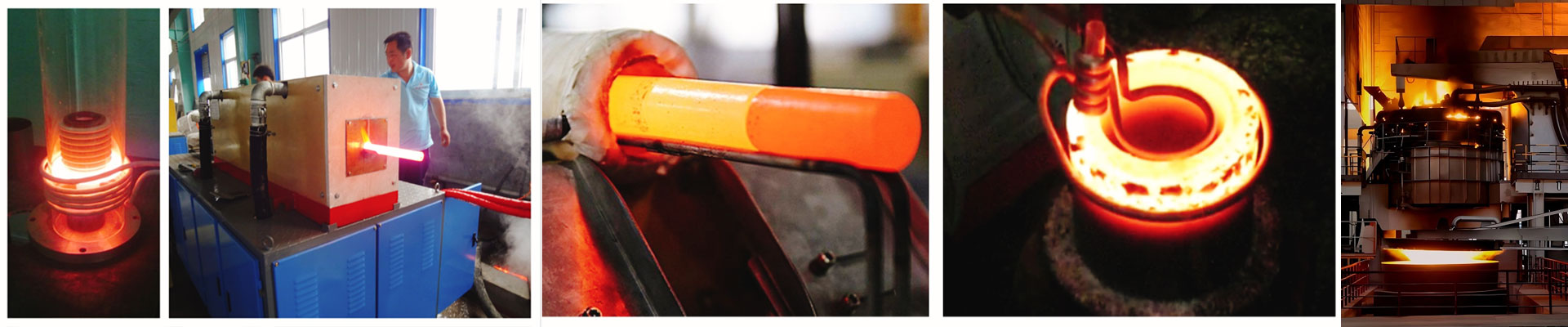
The forging furnace is the frontline equipment in any forge shop. It receives cold billets or bars and discharges them at precisely the right temperature — typically 1150-1250°C for steel forging — every 30 to 90 seconds, all day, every day. Reliability and temperature uniformity are not optional: a furnace that drifts 30°C from setpoint can ruin a day's production, and a furnace that breaks down stops the press or hammer and sends the forging crew home.
MONTE INTELLIGENCE supplies gas-fired forging furnaces — both batch (bogie hearth) and continuous (pusher, walking beam, rotary hearth) — to forging operations in Asia and the Middle East. This article covers the design and operating factors that determine forging furnace performance.
The forging temperature for steel is in the hot working range, above the recrystallization temperature where the metal softens and can be deformed with lower forces. For medium carbon and alloy steels, the forging temperature range is typically 1150-1250°C. The upper limit is set by the burning temperature — the temperature at which grain boundary melting begins (about 1250-1300°C for many steels) — and by the scale formation rate, which increases exponentially with temperature. The lower limit is set by the required forging force and the risk of cracking in the workpiece.
Temperature uniformity in the forging furnace determines the uniformity of metal flow during forging. A billet that is 1200°C at one end and 1150°C at the other will flow differently at each end, potentially causing die fill problems, dimensional variation, or cracking at the colder end. The standard requirement for forging furnace temperature uniformity is ±14°C (Class 5 per AMS 2750) to ±28°C (Class 6), which is looser than heat treatment uniformity requirements because the subsequent forging process redistributes the metal and any small temperature variations are averaged out.
The heating rate for forging must balance productivity against the risk of thermal stress cracking in the workpiece. A 200 mm diameter billet of tool steel heated from ambient at 100°C per minute may crack from the thermal stress between the hot surface and the cold core. The maximum safe heating rate depends on the steel grade, the cross-section, and the initial temperature. High-carbon and high-alloy steels require slower heating rates than plain carbon steels. Cold billets in winter (starting at 0°C) require slower heating than billets preheated by storage in a warm area.
Scale formation is the oxidation of the steel surface during heating in the forging furnace. The scale layer — iron oxide, FeO, Fe3O4, Fe2O3 — represents a material loss (typically 1-3% of the billet weight), a die wear accelerant (scale is abrasive and wears the forging die surfaces faster than clean metal), and a surface finish problem (embedded scale in the forging surface requires more machining allowance).
Scale formation rate is primarily a function of temperature and time. At 1200°C, a carbon steel billet in air will form approximately 0.1 mm of scale in 15 minutes. After 60 minutes, the scale thickness may be 0.3-0.5 mm. The exponential temperature dependence means that a 50°C increase in furnace temperature can double the scale formation rate. This is one reason why precise temperature control has economic value beyond energy savings — it directly reduces material loss to scale.
Reducing atmosphere operation — burning the gas with less than the stoichiometric amount of air, producing CO and H2 in the combustion products — can reduce scale formation. The CO and H2 react with iron oxides, reducing them back to metallic iron. However, operating fuel-rich produces soot, increases CO emissions, and introduces a safety concern (combustible gases in the flue system). A modest fuel-rich condition — 5-10% below stoichiometric air, often called a "reducing flame" — is used in some forging furnaces to control scale, but it requires careful burner adjustment and flue gas monitoring.
Throughput for a continuous forging furnace depends on the furnace heated length, the billet size, and the required heating time. The heating time for steel billets can be estimated from the cross-section: approximately 5-6 minutes per 25 mm of diameter for round billets heated in a well-stirred gas furnace at 1200°C. A 100 mm diameter billet requires about 22-25 minutes to reach uniform forging temperature. With a furnace heated length of 6 meters and a billet spacing of 200 mm on the hearth, the furnace holds about 30 billets, and at 25 minutes per billet, the throughput is 30 / 25 × 60 = 72 billets per hour.
The furnace atmosphere circulation — the movement of hot combustion gases around the billets — is the mechanism for convective heat transfer. Natural convection in a hot furnace provides some circulation, but for uniform heating at high throughput, recirculation fans are necessary. The fans, typically mounted in the furnace roof or sidewalls, draw hot gases from the furnace chamber and discharge them back into the chamber at high velocity, creating a stirred environment that heats all surfaces of the billets uniformly.
MONTE INTELLIGENCE forging furnaces are designed for 24/7 operation with robust refractory lining, industrial-duty burners, and control systems configured for the thermal cycling that forging operations demand.
For a forging furnace proposal based on your production requirements, contact helenxu@cnlymonte.com.
