
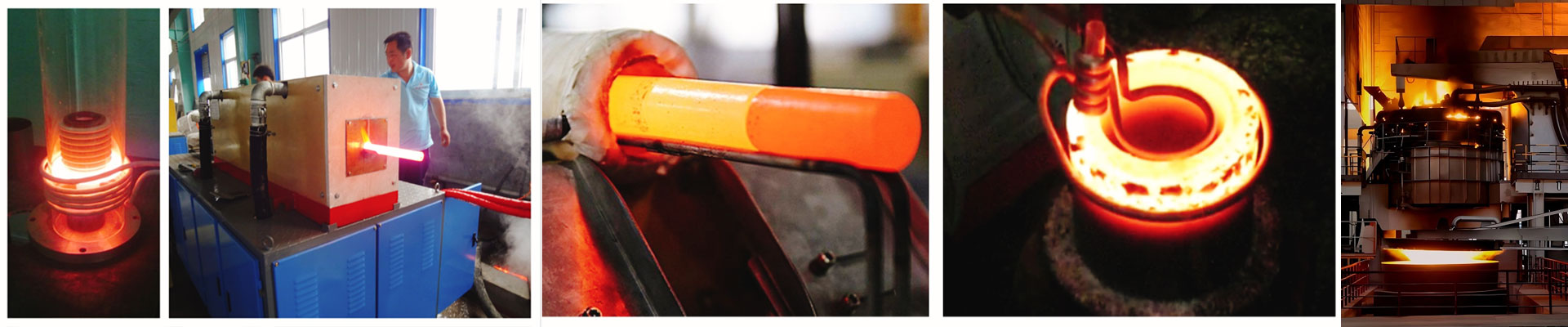
Heat Treatment of Large Forgings: How Bogie Hearth Furnaces Handle Wind, Power, and Pressure Components
A 200-ton generator rotor forging does not go in an oven. It goes in a bogie hearth furnace that is 30 meters long and 6 meters wide, with radiant tubes rated for 1050 degrees C, recirculation fans that move 200,000 cubic meters per hour of atmosphere, and a temperature uniformity of plus or minus 5 degrees C from corner to corner. The forging sits on the bogie for 5 to 10 days, ramping slowly through austenitization, soaking for hours, and cooling at a controlled rate. Miss a step and the forging fails in service. Hit every step and the forging runs for 30 years in a power plant.
Here is how the heat treatment of large forgings actually works.
The starting point is the forging specification.
Wind turbine main shafts, generator rotors, turbine rotors, pressure vessel shells, nuclear reactor components - each has a heat treatment specification written into the design code. ASME Section I, Section VIII, EN 10028, EN 10222, and various customer-specific specs (Siemens, GE, MAN, Mitsubishi) define the required mechanical properties, the temperature range, the hold time, the cooling rate, and the testing requirements.
The spec drives the heat treatment cycle. A typical large forging heat treatment cycle looks like this:
Pre-heat (slow ramp from ambient to 400 to 600 degrees C at 50 to 100 degrees C per hour). The slow ramp avoids thermal shock on a cold forging.
2. Heat to austenitization temperature (typically 850 to 950 degrees C for normalizing, 950 to 1050 degrees C for annealing or quenching). The ramp rate in this phase is 100 to 150 degrees C per hour.
3. Soak at temperature (1 to 4 hours per 100 mm of section thickness, sometimes longer). The soak homogenizes the temperature through the forging.
4. Controlled cool. For normalizing, the forging cools in still air. For annealing, it cools in the furnace to below 400 degrees C at a controlled rate. For quenching, it transfers to a water or oil bath.
5. Tempering (re-heat to 550 to 700 degrees C, soak, cool). The tempering step is repeated for some specs.
A 500 mm thick forging on this cycle takes 3 to 5 days from loading to discharge. The furnace is committed for the whole cycle - no opportunity to slot in a smaller heat.
Temperature uniformity is the make-or-break spec.
For a 30-meter-long furnace with a 200-ton forging, the temperature difference between the hottest and coldest point in the chamber has to be plus or minus 5 to 10 degrees C during the soak. Anything wider and the forging develops uneven microstructure. The cold spots normalize or anneal incompletely, the hot spots grain-coarsen, and the mechanical properties vary across the forging.
Achieving that uniformity requires a serious recirculation system. The furnace has high-velocity fans or jets that pull hot gas from the top and push it down through the workpiece. The fan motors are 30 to 75 kW each, and there are 4 to 8 of them distributed around the chamber. The recirculation ducts are sized to move 150,000 to 300,000 cubic meters of atmosphere per hour.
The radiant tube layout is also designed for uniformity. The tubes are arranged in zones - typically 4 to 6 zones along the length of the furnace and 2 to 3 zones from top to bottom. Each zone has its own burner set and its own temperature control loop. The control system reads multiple thermocouples in each zone and modulates the burner firing rate to maintain the setpoint.
Thermocouple placement is critical. The control thermocouples are typically 1.5 to 2 meters from the workpiece surface, in the gas space. The "witness" or "load" thermocouples are inserted into drilled holes in test pieces or in low-stress areas of the actual forging. The witness thermocouples are the legal record of the heat treatment - they confirm that the forging actually reached the required temperature for the required time.
For critical components (nuclear, high-pressure rotors), the spec may require multiple thermocouples in the forging, including in the thickest section and the thinnest section. The data logger records all thermocouples throughout the cycle, and the data becomes part of the quality package for the forging.
The soaking time is a function of section thickness.
The rule of thumb is 1 hour per 25 mm of section thickness for austenitization, sometimes 1 hour per 20 mm for high-alloy steels. A 500 mm thick forging needs 20 to 25 hours of soak time after the furnace reaches setpoint. That is on top of the heat-up time. The heat-up itself takes 8 to 12 hours at 100 degrees C per hour.
The total cycle is dominated by the heat-up and the soak. The cool-down is usually faster, particularly for normalizing (still air cool) or for oil quenching (the quench itself is 4 to 8 hours for a 200-ton forging). The furnace cool-down to 400 degrees C takes 6 to 10 hours, depending on the desired cooling rate.
Atmosphere control is the variable that determines the surface condition.
For stress relief and normalizing, a slightly oxidizing atmosphere is acceptable - the forging develops a thin oxide scale that is removed by shot blasting after the heat treatment. For annealing or for components that require a machined surface finish, a controlled atmosphere is needed to minimize scale and decarburization.
The atmosphere is controlled by maintaining a slight positive pressure in the furnace (typically 1 to 5 mbar above atmospheric) and bleeding in a small amount of air or inert gas. Some large bogie hearths have a full muffle design - an inner gas-tight chamber that isolates the workpiece from the combustion gases. The muffle is expensive but it gives precise atmosphere control.
For components that require decarburization-free surface (like bearing seats on large rotors), the spec calls for a protective atmosphere - typically nitrogen with a few percent of a reducing gas (hydrogen or dissociated ammonia). The furnace is sealed, the air is purged, and the protective atmosphere is maintained throughout the cycle. Decarburization depth is typically limited to 0.5 mm or less in this mode.
Loading and discharge of large forgings is a major operation.
A 200-ton forging on the bogie requires a heavy-lift crane - typically 300 to 500 ton capacity with a lifting beam. The loading operation takes 30 to 60 minutes with a full crew. The forge arrives at the bay, the crane lifts it, the bogie is positioned, the forging is lowered onto the hearth, and the lifting rigging is removed. The bogie then travels into the furnace, the door closes, and the heat cycle starts.
The fixture for a large forging is typically a heavy steel or cast base with locating features. For a rotor shaft, the fixture might be a long bed of V-blocks spaced along the length, supporting the shaft at multiple points. For a ring or shell, the fixture is a flat base with the part standing on edge.
Discharge is the reverse - the bogie travels out, the crane picks the forging, and the forging transfers to the next operation (machining, testing, or further heat treatment). The crane operator works from an air-conditioned cab because the radiant heat from the forging is intense - 200 to 500 degrees C at the surface, even after the discharge cycle.
The bottom line. Large forging heat treatment is a specialty operation that requires:
- A large, well-instrumented bogie hearth furnace
- Precise atmosphere control
- Skilled operators who understand the spec
- Heavy-lift cranes and fixtures
- Detailed cycle documentation for every heat
Author: MONTE INTELLIGENCE large forging heat treatment team. For forging heat treatment studies and furnace audits, contact helenxu@cnlymonte.com.
