
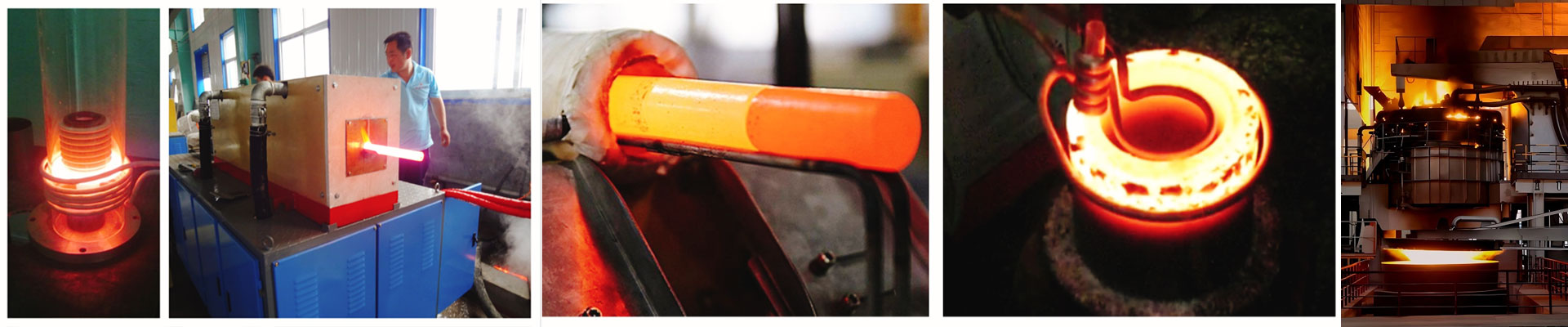
Induction Hardening vs Laser Hardening: Comparing Two Surface Treatment Routes
Surface hardening of steel components is a multi-billion dollar industry. The two most common methods today are induction hardening and laser hardening. Both produce a hard wear-resistant surface on a tough ductile core, but they do it through different physics, different equipment, and different economics. Picking the right one for a given application requires understanding what each method does well, and where each one falls short.
Here is how the comparison actually works.
The basic principle is the same.
Both methods heat the surface of the steel to the austenitizing temperature (typically 850 to 1050 degrees C, depending on the carbon content), then quench the surface to form martensite. The result is a hard case (typically 55 to 65 HRC) on a tough core (typically 20 to 35 HRC, depending on the core microstructure). The case depth and the hardness profile depend on the heating method, the steel composition, and the quench.
The difference is in how the heating is done.
In induction hardening, an alternating magnetic field from a coil induces eddy currents in the surface of the steel. The eddy currents heat the surface through I^2R losses. The depth of heating depends on the frequency - higher frequency gives shallower heating, lower frequency gives deeper heating.
In laser hardening, a high-power laser beam (typically a CO2 laser or a fiber laser) is focused on the surface of the steel. The laser energy is absorbed by the surface and converted to heat. The depth of heating depends on the laser power, the beam diameter, the traverse speed, and the absorption coefficient of the steel.
The depth of heating is the first major difference.
Induction hardening can produce case depths from 0.5 mm to over 10 mm. The frequency range covers 1 kHz (deep case, up to 10 mm) to 500 kHz (shallow case, 0.5 mm). For most industrial applications, the case depth is 1 to 5 mm, which is well within the induction range.
Laser hardening typically produces case depths from 0.3 mm to 2 mm. The shallow depth is a fundamental limit of the laser process - the energy is concentrated at the surface, and the heat diffuses into the material by conduction. The diffusion depth at the typical traverse speeds (0.5 to 5 m/min) limits the practical case depth to about 2 mm. Going deeper requires a longer dwell time, which risks surface melting.
So laser hardening is the choice for shallow case depths (0.3 to 1.5 mm) and induction hardening is the choice for deeper case depths (1.5 to 10 mm). The overlap zone is 1 to 2 mm, where both methods can work and the choice depends on other factors.
The heating rate is the second major difference.
Induction heating is fast but not as fast as laser. The typical heating rate in induction hardening is 100 to 1000 degrees C per second. The steel reaches the austenitizing temperature in 0.5 to 5 seconds, depending on the case depth and the power input.
Laser heating is much faster. The typical heating rate in laser hardening is 1000 to 100,000 degrees C per second. The steel reaches the austenitizing temperature in 0.01 to 0.5 seconds. The very fast heating produces a very fine austenite grain, which transforms to a very fine martensite on quenching.
The fine martensite from laser hardening has higher hardness and better wear resistance than the coarser martensite from induction hardening. The difference is typically 2 to 5 HRC at the same carbon content. For wear-critical applications (cutting tools, gears under high load), the laser hardening advantage is real.
The quench is the third major difference.
In induction hardening, the quench is usually self-quench - the cold mass of the steel below the heated surface conducts heat away from the surface fast enough to form martensite. For deeper case depths, an external quench (water spray or polymer dip) is used to speed up the cooling.
In laser hardening, the quench is also typically self-quench for shallow cases, but the very shallow case depth means the quench rate is very high. The result is a very hard, very fine martensite with minimal residual stress.
The distortion is the fourth major difference.
Induction hardening causes some distortion, mainly from the thermal gradient during heating and the volumetric change during martensite formation. The distortion is typically 0.05 to 0.20 mm on a 50 mm diameter shaft, depending on the case depth and the steel. For most industrial applications, the distortion is acceptable or can be corrected by a subsequent grinding operation.
Laser hardening causes very little distortion. The heated zone is small, the heating time is short, and the bulk of the part stays cold. The result is a distortion of 0.01 to 0.05 mm on a 50 mm diameter shaft. For precision components (gears, bearings, shafts with tight tolerances), the low distortion of laser hardening is a major advantage.
The equipment cost is the fifth major difference.
Induction hardening equipment ranges from a small, manually-operated unit (a few thousand dollars) to a large, fully automated CNC scanner system (a few hundred thousand to a few million dollars). A typical industrial induction scanner system for shaft hardening costs $200,000 to $1,000,000 installed.
Laser hardening equipment is generally more expensive. A high-power fiber laser (4 to 10 kW) costs $200,000 to $500,000. A CO2 laser (2 to 5 kW) costs $100,000 to $300,000. A complete laser hardening system with beam delivery, scanner head, and CNC control costs $500,000 to $2,000,000 installed.
The operating cost is the sixth major difference.
Induction hardening is relatively efficient. The electrical efficiency of an induction scanner (input power to power delivered to the part) is typically 60 to 80 percent. The cost is mostly electricity and coolant water.
Laser hardening is less efficient. The wall-plug efficiency of a fiber laser is typically 30 to 40 percent. The wall-plug efficiency of a CO2 laser is typically 10 to 20 percent. The result is higher electricity cost per part for laser hardening, even though the heating time is shorter.
The throughput is the seventh major difference.
Induction hardening is generally faster per part. A typical induction scanner can harden a 500 mm long shaft in 30 to 60 seconds, including loading and unloading. The induction process itself takes 5 to 15 seconds.
Laser hardening is generally slower per part. A typical laser hardening system can harden a 500 mm long shaft in 5 to 15 minutes, because the laser beam covers a smaller area at a time. For high-volume production, the throughput difference is a major factor.
The summary of the comparison:
| Factor | Induction Hardening | Laser Hardening |
|--------|--------------------|-----------------|
| Case depth | 0.5 to 10+ mm | 0.3 to 2 mm |
| Heating rate | 100 to 1000 C/s | 1000 to 100,000 C/s |
| Hardness | 55 to 62 HRC | 58 to 65 HRC |
| Distortion | Moderate | Low |
| Equipment cost | Lower | Higher |
| Operating cost | Lower | Higher |
| Throughput | Higher | Lower |
| Energy efficiency | Higher | Lower |
The application rules of thumb.
Induction hardening is the right choice for:
- Case depths 1.5 to 10 mm
- High-volume production
- Components where moderate distortion is acceptable
- Cost-sensitive applications
- Larger parts (shafts, gears, large rollers)
Laser hardening is the right choice for:
- Case depths 0.3 to 1.5 mm
- Low to medium volume production
- Components where low distortion is critical
- Wear-critical surfaces where the fine martensite advantage matters
- Small or complex surfaces (gear teeth, cam lobes, intricate shapes)
Author: MONTE INTELLIGENCE surface hardening engineering team. For induction and laser hardening system selection, contact helenxu@cnlymonte.com.
