
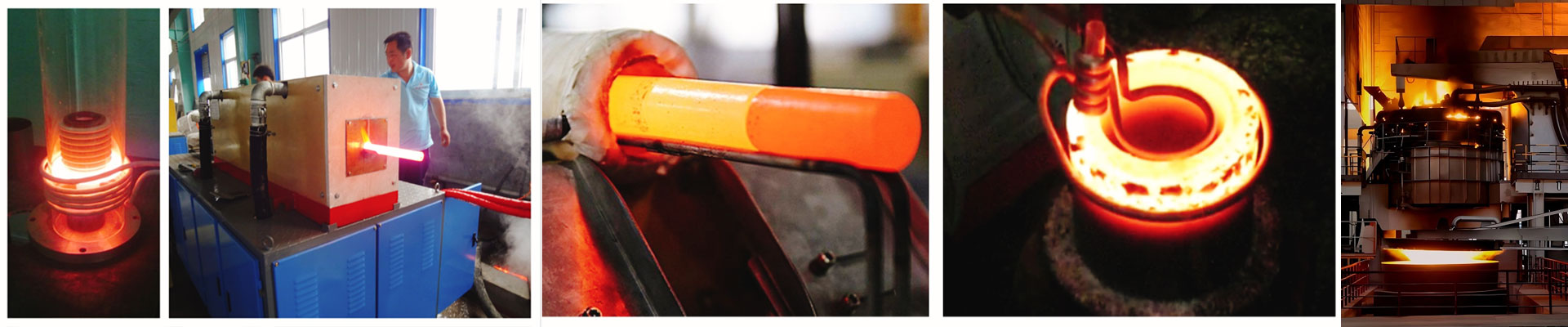
Induction Brazing and Soldering: How to Set Up a Reliable Production Process
Induction brazing is one of the fastest, most controllable ways to join metal components. The induction coil heats the joint area to the filler metal melting point in seconds, the filler flows into the joint by capillary action, and the joint is made. Done right, induction brazing produces consistent, high-quality joints at high production rates with minimal operator skill. Done wrong, the joints are dry, porous, or weak. The setup is the key.
Here is how a reliable induction brazing process actually gets built.
Start with the joint design.
The joint is the most important variable in any brazing process. A good brazed joint has:
- A small, uniform gap between the parts (typically 0.05 to 0.20 mm for capillary action)
- Sufficient overlap between the parts (typically 3 to 6 times the thinnest wall thickness)
- Surfaces that are clean and free of oxide, oil, and dirt
- Geometry that allows the filler to flow into the joint by gravity or capillary action
- Access for the induction coil to heat the joint area
A bad joint has gaps that are too wide (no capillary action), gaps that are too narrow (no filler flow), contaminated surfaces (filler does not wet), or inaccessible geometry (coil cannot heat the joint uniformly).
The joint clearance is the most critical variable. The filler metal flows into the joint by capillary action, which depends on the surface tension of the filler, the wetting angle with the base metal, and the gap width. The optimal gap is 0.05 to 0.15 mm for most silver-based fillers and 0.02 to 0.10 mm for most copper-based fillers. Gaps outside this range result in incomplete filling, porosity, or weak joints.
The filler metal selection is the second decision.
Common filler metals for induction brazing include:
- Silver-based fillers (BAg series, melting range 600 to 800 degrees C) - the most common, good for most steels, copper, and copper alloys
- Copper-based fillers (BCu series, melting range 1100 to 1150 degrees C) - for high-temperature joints, requires reducing atmosphere
- Copper-phosphorus fillers (BCuP series, melting range 700 to 850 degrees C) - for copper-to-copper joints without flux
- Nickel-based fillers (BNi series, melting range 900 to 1200 degrees C) - for high-temperature and corrosive service
- Aluminum-based fillers (BAlSi series, melting range 580 to 620 degrees C) - for aluminum-to-aluminum joints
The filler metal form is also a choice. Filler is available as wire, rod, strip, preformed rings, paste, and powder. For induction brazing, preformed rings or stamped shims are common for round joints (tube-to-fitting). Wire or rod is common for hand-fed or automated fed joints. Paste is common for joints with complex geometry.
For high-volume production, preformed filler rings or shims give the most consistent results. The operator (or the automation) places the filler, positions the parts, and the induction cycle does the rest. The filler quantity is controlled by the preform size, and the placement is repeatable.
The flux is the third decision.
Most brazing operations use a flux to dissolve the oxide on the base metal surfaces and allow the filler to wet. The flux is applied as a paste, a liquid, or a powder. For induction brazing, paste flux is the most common because it stays in place during heating.
The flux has to be active at the brazing temperature and chemically compatible with the base metal and the filler. For silver brazing of steel, a general-purpose borax-boric acid flux works. For stainless steel brazing, a more aggressive fluoride-containing flux is needed. For aluminum brazing, a special aluminum brazing flux is required.
Some brazing processes use a self-fluxing filler (like BCuP for copper) or a protective atmosphere (hydrogen, dissociated ammonia, or argon) to avoid the need for flux. Atmosphere brazing is cleaner and more consistent, but it requires a controlled-atmosphere chamber and is more expensive.
The induction coil design is the fourth decision.
The coil has to deliver heat to the joint area without overheating the rest of the part. The coil design depends on the part geometry, the joint location, and the production rate.
For a simple cylindrical joint (a tube inserted into a fitting), a single-turn helical coil that surrounds the joint area works well. The coil is positioned 2 to 5 mm from the part, and the part is held in a fixture that rotates or indexes through the coil.
For a more complex geometry (a fitting with multiple ports, a manifold with several branches), a custom coil that conforms to the part shape is needed. The custom coil is designed using electromagnetic simulation (FEA) to ensure uniform heating across the joint area.
For high-volume production, a multi-position coil or a traversing coil can braze multiple joints in sequence. The part moves through the coil on a conveyor or a rotary table, and each joint is brazed in turn.
The brazing parameters are the fifth decision.
The key parameters are:
- Power input (kW) - higher power means faster heating, but more risk of overheating
- Frequency (kHz) - higher frequency means shallower heating, more surface heating; lower frequency means deeper heating, more bulk heating
- Heating time (seconds) - shorter time means less total heat input, but harder to control
- Coil-to-part gap (mm) - smaller gap means more efficient heating, but less uniform
- Cool-down time (seconds) - the joint has to cool below the solidus temperature before it is moved
A typical induction brazing cycle for a 25 mm diameter steel tube joint is 5 to 15 seconds at 5 to 15 kW, with a 5 to 10 second cool-down. The cycle is fast - much faster than torch brazing, which can take 30 to 60 seconds per joint.
The cycle is typically controlled by a PLC or a dedicated induction heating controller. The controller monitors the temperature (using an infrared pyrometer or a thermocouple) and adjusts the power to maintain the setpoint. The cycle ends when the joint has been above the filler liquidus temperature for the required time, and the part is then cooled.
The fixture is the sixth decision.
The fixture holds the parts in the correct position during brazing. The fixture has to:
- Hold the parts in the correct relative position (the joint gap)
- Be transparent to the induction field (use non-metallic materials like stainless steel, ceramics, or phenolics)
- Allow the coil to access the joint area
- Allow the filler to flow into the joint (open around the joint)
- Cool the parts after brazing (water-cooled base or forced air)
A bad fixture lets the parts move during heating, which changes the gap and the filler flow. The joint comes out dry or weak. A good fixture is repeatable, dimensionally stable, and designed to manage the thermal expansion of the parts during heating.
The process control is the seventh decision.
For consistent quality, the brazing process has to be controlled. The key variables to monitor are:
- Joint temperature (infrared pyrometer aimed at the joint area)
- Power input (kW meter on the power supply)
- Cycle time (timer on the controller)
- Cool-down time (timer on the controller)
The data is logged for every joint. Trends are tracked. Out-of-spec joints are flagged. The process is adjusted when the data drifts.
For high-volume production, the process control can be fully automated. The parts are loaded, the filler is placed, the parts are positioned in the fixture, the coil energizes, the cycle runs, the parts cool, and the parts are unloaded - all without operator intervention. The operator supervises the line, handles exceptions, and performs the periodic quality checks.
Author: MONTE INTELLIGENCE induction brazing engineering team. For induction brazing system design and process development, contact helenxu@cnlymonte.com.
