
Electric Arc Furnace vs Induction Furnace: Which Is Right for Your Steel Plant?
When your plant needs a new melting furnace, the electric arc furnace vs induction furnace debate can feel like choosing between two completely different worlds — and the wrong pick could cost you millions. Here's the honest answer: if you're running large-scale carbon or alloy steel production from scrap, an EAF is almost always the right call; if you're melting small batches of precision alloys with tight composition tolerances, an induction furnace likely wins. But the real decision depends on your raw materials, production volume, energy rates, and capital budget — and no single article can replace a plant-specific engineering study.
At Monte Intelligence, we manufacture both EAFs and induction furnaces, so we have no dog in this fight. What follows is an unbiased, data-driven comparison based on decades of field experience across steel plants in over 30 countries. No sales spin — just the numbers and scenarios you need to make the right call.
You're investing capital that will shape your plant's competitiveness for the next 15–20 years. The furnace you choose determines your raw material costs, energy bills, product quality ceiling, and expansion options. Below, we'll break down how each technology works, compare them across eight critical factors, walk through real-world decision scenarios, and show you when a hybrid setup might actually be the smartest move.
Key Takeaways- EAFs handle 400-ton heats and accept all scrap grades; induction furnaces max out around 20–30 tons and require clean, sorted charge material.- At scale (>150,000 t/year), EAFs consume 340–380 kWh/t vs. induction's 450–550 kWh/t — a 15–30% energy cost advantage.- Induction furnaces offer 30–50% lower initial capital cost and simpler operation, making them ideal for startups and small foundries.- EAFs provide full metallurgical refining (decarburization, desulfurization, dephosphorization) in a single vessel; induction furnaces can only melt — refining requires a separate ladle furnace.- Plants producing >150 kt/year are almost always more profitable with EAF technology; below 50 kt/year, induction often wins on ROI.
How They Work: Fundamental Differences
Before we compare numbers, you need to understand why these furnaces behave so differently. The root cause is simple: they generate heat in completely different ways.
EAF — Electric Arc Heating
An electric arc furnace creates heat the same way lightning does — by striking an arc. Three graphite electrodes descend into the furnace vessel, and when power is applied, arcs form between the electrode tips and the metallic charge. Those arcs reach temperatures of 3,000–3,500°C, hot enough to melt anything you put in the furnace — and to drive powerful metallurgical reactions in the slag layer above the steel.
This extreme temperature isn't just about raw melting power. It's what enables the EAF's signature capability: in-vessel refining. The superheated slag layer (hotter than the steel bath itself) actively participates in chemical reactions — removing sulfur, phosphorus, and carbon to specification without transferring the heat to a separate vessel.
Modern EAFs also inject oxygen and natural gas through sidewall lances, which contributes 25–30% of total energy input from chemical reactions. This isn't auxiliary heating — it's core process chemistry that reduces electrical consumption while improving steel quality.
Want to understand the EAF process in more depth? Read our detailed guide to how electric arc furnaces work →
Induction Furnace — Electromagnetic Induction Heating
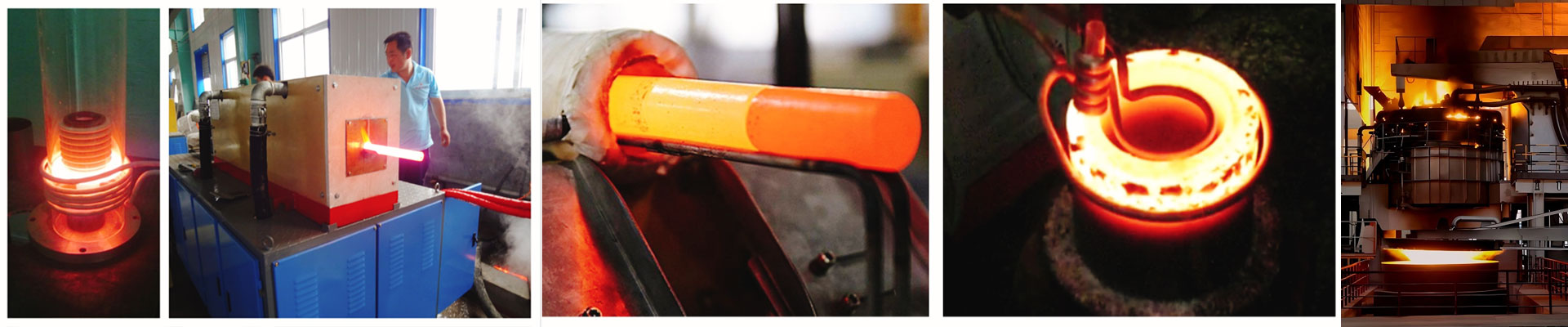
An induction furnace works on the same principle as your kitchen induction cooktop — just scaled up by a factor of about 10,000. An alternating current flows through a copper coil surrounding a refractory crucible, generating a rapidly oscillating magnetic field. That field induces eddy currents directly inside the metal charge, and the electrical resistance of the metal converts those currents into heat.
The metal heats itself from within. There are no electrodes, no arcs, and no combustion gases. The result is remarkably clean, uniform heating — the bath composition and temperature are the most homogeneous of any commercial melting technology.
But there's a trade-off: the maximum temperature is limited by the metal's own properties and the crucible's refractory lining. For steel, practical limits sit around 1,600–1,700°C. That's more than enough for melting — but insufficient to drive the aggressive slag chemistry that gives the EAF its refining power. An induction furnace is, fundamentally, a melting-only device. Any refining has to happen somewhere else.
\[Image suggestion: Side-by-side cross-section diagrams showing EAF arc heating vs. induction coil heating\]
Head-to-Head Comparison: 8 Critical Factors
This is where the electric arc furnace vs induction furnace debate gets real. We've seen plants make this decision based on a single factor and regret it for years. Here are the eight variables that actually matter — with numbers.
1. Raw Material Flexibility
This is often the factor that makes or breaks a plant's economics, and the gap between the two technologies is enormous.
EAF accepts virtually any ferrous charge material:
- Shredded auto scrap with oil and coatings? No problem — the EAF burns off contaminants and captures emissions through the off-gas system.
- HMS #1 and #2 heavy melting steel? Standard feedstock.
- DRI/HBI (direct reduced iron / hot briquetted iron)? The EAF was practically designed for it. DRI charging is a core EAF application.
- Slag-carrying scrap? The EAF slag system handles it routinely.
Induction furnaces are far more restrictive:
- Charge material must be clean, rust-free, and oil-free. Contaminants cause slag buildup that destroys the crucible lining.
- Pieces must be sized to fit the crucible and avoid "bridging" — where scrap forms an arch above the melt, creating a dangerous void that can cause explosive eruptions when it collapses.
- DRI/HBI cannot be used as a primary charge — the fines and low bulk density cause severe operational problems.
- You're essentially limited to clean HMS #1 or pre-sorted, verified scrap — and you'll pay a premium for it.
The bottom line: In regions with abundant, cheap mixed scrap, the EAF's raw material flexibility alone can save $20–40/t in input costs. In markets where only clean, sorted scrap is available at reasonable prices, this advantage diminishes.
2. Energy Efficiency and Power Consumption
At first glance, induction furnaces seem more energy-efficient — and at very small scales, they are. The direct electromagnetic coupling means less heat escapes to the environment. But at production scale, the math flips.
| Metric | EAF | Induction Furnace |
| Electrical energy (large scale) | 340–380 kWh/t | 450–550 kWh/t |
| Chemical energy contribution | 25–30% of total input | 0% |
| Power factor (modern) | >0.97 (with SVC) | 0.85–0.90 |
| Grid impact | Requires SVC/filter compensation | Lower flicker, easier grid connection |
Here's why EAFs win at scale: they're not purely electric. The oxygen and natural gas injection contributes roughly a quarter of the total energy input from chemical reactions. When you account for total energy per ton of steel — electrical plus chemical — the EAF at >150,000 t/year typically uses 15–30% less total energy than an equivalent-output induction plant.
For induction furnaces, there's an additional hidden cost: if you need refining (and for most steel grades, you do), you must add a separate ladle refining furnace (LRF). That adds 20–30% more energy consumption on top of the base melting figure.
When induction wins on energy: At small batch sizes (<5 t/heats) where the EAF's arc stability and thermal losses are harder to manage, induction's direct coupling is genuinely more efficient.
Curious about reducing your furnace energy costs? See Monte Intelligence's energy-optimized EAF solutions →
3. Steel Quality and Grade Range
Both furnaces produce excellent steel — but they reach different quality ceilings through different paths.
EAF advantages:
- Full metallurgical refining in one vessel: Decarburization to <0.05% C, desulfurization, dephosphorization, and alloying — all without transferring the heat.
- Foamy slag practice protects the bath from nitrogen and hydrogen pickup, critical for clean steel grades.
- Wide grade range: From low-carbon structural steels to high-alloy tool steels and stainless grades.
Induction furnace advantages:
- Superior composition uniformity: The electromagnetic stirring is inherent to the process — no mechanical stirring needed. Temperature and chemistry are consistent throughout the bath.
- Minimal element burnout: No arc means no localized overheating, so alloying elements like chromium, manganese, and silicon have higher yield rates.
- Cleaner melt atmosphere: No electrode carbon pickup, no combustion gases — critical for ultra-low-carbon and specialty alloys.
The catch for induction: Without refining capability, your steel quality is only as good as your scrap. If you need to produce low-carbon steel from high-carbon scrap, the induction furnace literally cannot remove that carbon — you'd need an AOD or LRF station.
4. Production Capacity and Scale
This is where the two technologies diverge most dramatically.
| Metric | EAF | Induction Furnace |
| Maximum single heat size | Up to 400 tons | 20–30 tons (practical max) |
| Melt rate (100-ton equivalent) | 38–42 minutes | 120–150 minutes |
| Annual output per unit | 500,000+ t/year | 50,000–80,000 t/year |
| Heat-to-heat cycle time | 35–50 min (tap-to-tap) | 90–150 min |
For a sense of scale: Nucor's Berlin plant operates EAFs with 400-ton tap capacity. The largest practical induction furnaces top out around 20–30 tons. That's not a marginal difference — it's an order of magnitude.
At the same furnace volume, an induction furnace produces approximately 70% of an EAF's output due to longer cycle times and the need for separate refining steps.
When does scale matter? If your business plan calls for >150,000 t/year, the EAF is the only technology that makes technical and economic sense. Period. Below 50,000 t/year, induction's simpler infrastructure and lower capital cost become compelling.
5. Capital and Operating Costs
Let's talk money — the factor that ultimately drives most purchase decisions.
Capital expenditure (CapEx):
- A complete EAF system — including the furnace, transformer, SVC, oxygen lances, water-cooling system, off-gas treatment, and crane/charging system — costs roughly 2–3× what an equivalent-capacity induction furnace installation costs.
- Induction furnaces require no electrodes, no off-gas treatment (for clean scrap), no oxygen injection system, and simpler foundations. For a startup operation, this can mean the difference between "we can afford this" and "we can't start."
- However, if your induction furnace needs a separate LRF/AOD for refining, add $1.5–3 million per station to the induction plant's price tag.
Operating expenditure (OpEx):
| Cost Item | EAF | Induction Furnace |
| Raw material cost | Lower (accepts cheap mixed scrap) | Higher (requires clean sorted scrap) |
| Electrode consumption | <1.2 kg/t (UHP grade) | N/A (no electrodes) |
| Energy cost per ton | Lower at scale | Higher at scale |
| Refractory/lining cost | Modular patching, zone replacement | Full crucible replacement every 150–250 heats |
| Labor | 0.8 man-hours/t | 1.6 man-hours/t |
| Net operating cost advantage | $15–25/t lower than induction | — |
The total picture: EAFs cost more upfront but less to operate — especially at scale. Over a 15-year equipment life, the operating cost savings typically overwhelm the higher initial investment for any plant running >100,000 t/year.
Thinking about an EAF investment? See our EAF buying guide for a complete cost planning framework →
6. Environmental Impact and Emissions
Both technologies are electric — so neither has the blast furnace's fundamental CO₂ problem. But they're not equal.
| Emission Metric | EAF | Induction Furnace |
| CO₂ (grid-based) | 0.8–1.1 t/t | 1.2–1.5 t/t |
| Fugitive emissions | Captured via off-gas system | Minimal (no off-gas) |
| Noise level | 100–110 dB (arc noise) | 80–90 dB |
| Dust/particulate | 10–15 kg/t (captured by baghouse) | 2–5 kg/t |
| Future green potential | Hydrogen-ready with DRI-EAF route | Electric-only, no fuel switching |
Wait — the EAF has lower CO₂ per ton of steel? Yes, and here's why: despite using more total energy per ton at small scale, EAFs at production scale are significantly more energy-efficient per ton. Plus, the chemical energy from oxygen/gas injection partially displaces grid electricity, which in most countries carries a carbon multiplier.
The EAF also has a clearer decarbonization pathway. When paired with green hydrogen-based DRI (like the Midrex DRI-EAF process), emissions can drop below 0.5 t CO₂/t steel — a trajectory that simply doesn't exist for induction furnaces, which are locked to grid electricity.
On the other hand, induction furnaces win on local air quality: no arc means no fume generation, and the minimal dust is far easier to manage. For foundries in urban or regulated areas, this is a genuine advantage.
7. Maintenance Requirements
Neither furnace is maintenance-free, but the nature and frequency of maintenance differ significantly.
EAF maintenance:
- Electrode management is the most visible recurring task. Modern UHP electrodes consume <1.2 kg/t, but electrode breakage due to scrap collapse remains a risk. Monitoring electrode arm positioning and regulating slide-down rates are standard operating procedure.
- Refractory lining is maintained through zone-based patching — you replace the hot spots (sidewall slag line, hot heel) without relining the entire vessel. This extends campaign life and reduces downtime.
- Water-cooling panels require regular inspection for leaks, which can cause explosive steam events if water contacts the molten bath.
- Bottom stirring elements (argon or electromagnetic) need periodic replacement but extend lining life by reducing temperature gradients.
Induction furnace maintenance:
- Crucible replacement is the big one. Every 150–250 heats, the entire crucible lining must be torn out and relined — a 16–24 hour process that takes the furnace offline completely.
- Coil integrity is a safety-critical concern. A water leak from the induction coil into the refractory can cause explosive vaporization. Coil inspection and insulation testing are mandatory.
- Power supply (IGBT/SCR) failures require specialized technicians. When an IGBT module fails, you're not fixing it in-house — you're waiting for a replacement and possibly an engineer flight.
The practical difference: EAF maintenance can largely be scheduled around production cycles with hot patching and incremental repairs. Induction maintenance is more binary — the furnace runs until the crucible is spent, then it's down for a full day or more.
For a detailed maintenance planning guide, see our EAF maintenance best practices resource →
8. Process Control and Automation
Modern steelmaking is a data game. The furnace that's easier to automate has a meaningful competitive edge.
EAF:
- Modern EAFs run on sophisticated process control systems that dynamically adjust arc length, power input, oxygen injection, and alloy additions in real-time.
- Foamy slag practice is semi-automated — carbon injection and oxygen flow are regulated to maintain optimal slag height, protecting the refractory and improving energy efficiency.
- Integration with continuous casting machines is straightforward — the EAF's tap-to-tap cycle can be synchronized to the caster's pull rate, enabling sequence casting with minimal intermediate inventory.
- Digital twin and AI-based optimization systems are increasingly standard on new EAF installations.
Induction furnace:
- Temperature control is inherently precise — the electromagnetic stirring ensures uniform bath temperature, and power modulation provides ±5°C accuracy.
- Composition control is only as good as the charge. Without refining capability, the induction operator can add alloy but can't remove unwanted elements. The furnace cannot decarburize, desulfurize, or dephosphorize.
- Continuous casting synchronization is more difficult. The smaller heat size and longer cycle time create buffering challenges that reduce overall plant efficiency.
The net effect: EAFs offer broader automation potential, especially for integrated meltshop operations. Induction furnaces offer better point-control (temperature, composition uniformity) within their narrower process window.
\[Image suggestion: Screenshots or mockups of modern EAF vs. induction furnace control dashboards\]
Decision Framework: When to Choose EAF
Data is useful, but decisions happen in context. Here are three real-world scenarios where the EAF is clearly the right choice.
Scenario 1: Large-Scale Carbon Steel Production
Rajesh Kapoor runs a 500,000 t/year structural steel mini-mill outside Mumbai. When he started in 2018, his local scrap market offered mixed HMS #1/#2 at $30–40/t below clean, sorted prices. His EAF accepted that scrap directly — no sorting, no pre-cleaning, no premium.
"I looked at induction furnaces because the initial investment was lower," Kapoor says. "But when I calculated that I'd need to pay $35/t more for clean scrap — on 500,000 tons a year — that's $17.5 million annually. The EAF paid for its own higher CapEx in under two years."
At his production volume, the EAF's energy consumption sits at 365 kWh/t — well within the 340–380 range — while a comparable induction installation would run 480+ kWh/t. That's another $8–10/t in energy savings. Combined with the labor efficiency advantage (0.8 vs. 1.6 man-hours/t), his total operating cost advantage is approximately $20/t. Monte Intelligence supplied Rajesh's 80-ton AC EAF and provided 90 days of on-site process optimization that helped him reach nameplate capacity 4 months ahead of schedule.
Scenario 2: Scrap-Based Mini-Mill
If your business model is converting local scrap into long products (rebar, wire rod, sections), the EAF is your engine. The logic is simple:
- Scrap is your raw material. The EAF's ability to handle diverse scrap grades — including shredded, contaminated, and oversized material — gives you maximum purchasing flexibility.
- DRI/HBI blending lets you dilute residual elements (copper, tin) from scrap, extending your product grade range. Only the EAF can meaningfully charge DRI.
- Scale economics kick in above ~100,000 t/year. Below that threshold, the EAF's higher CapEx isn't amortized across enough production to justify itself.
The leading EAF-based mini-mill operators — Nucor, Steel Dynamics, Ternium — consistently achieve 18–22% EBITDA margins, a benchmark that induction-based steelmaking simply cannot match at commercial scale.
Scenario 3: High-Alloy and Specialty Steel
Producing stainless steels, tool steels, or high-alloy grades? The EAF's refining capability is essential. You can't make 304 stainless with 0.05% carbon from high-carbon charge material in an induction furnace — there's no way to remove the carbon. The EAF's oxygen blowing decarburizes to specification in a single heat.
Combined with an AOD (Argon Oxygen Decarburization) vessel for the final carbon adjustment, the EAF-AOD route is the global standard for stainless and specialty steel production.
Decision Framework: When to Choose Induction Furnace
The induction furnace isn't the wrong choice — it's the wrong choice at the wrong scale. Here are three scenarios where it clearly wins.
Scenario 4: Small-Batch Non-Ferrous Melting
Maria Santos operates a precision casting foundry in São Paulo that melts copper, brass, and bronze alloys in 500 kg to 3-ton batches. Her induction furnace is perfect for this work:
- Rapid alloy changeover — no residual heat contamination between heats. She can run a brass heat, then a copper heat, with zero cross-contamination.
- Precise temperature control — ±3°C for investment casting specifications.
- No electrode consumption, no arc glare, minimal fume — her foundry operates in an industrial park with strict emission limits, and the induction furnace needs no baghouse.
- Simple startup and shutdown — she can power down between orders and be back at temperature in 30 minutes.
For Maria's operation, an EAF would be absurd overkill — like using a sledgehammer to hang a picture frame.
Scenario 5: Precision Alloy Foundry
For foundries producing nickel-based superalloys, cobalt alloys, or other precision materials where composition uniformity is non-negotiable, the induction furnace's inherent electromagnetic stirring delivers the most homogeneous melt possible.
In these applications:
- Element burnout is minimal (no arc hot spots), improving yield of expensive alloying elements like chromium, molybdenum, and tungsten.
- The clean melting environment (no carbon pickup from electrodes, no combustion gases) is essential for ultra-low-carbon and ultra-low-nitrogen grades.
- Heat sizes are typically 1–10 tons — well within the induction furnace's sweet spot.
Scenario 6: Startup Steel Operation (Low CapEx)
Chen Wei had a scrap yard in Vietnam and a dream of making rebar. His budget was $2 million. An EAF installation — even a small one — would have cost $4–6 million once he factored in the transformer, SVC, off-gas system, and crane infrastructure.
Instead, he installed two 5-ton induction furnaces for under $1.5 million, including the power supply and basic casting line. His scrap was clean HMS #1 from his own yard, so raw material quality wasn't an issue. Within 18 months, his plant was cash-flow positive.
"Could I produce more with an EAF? Absolutely," Chen says. "But I couldn't afford to start with one. The induction furnace let me get into production, prove the market, and build revenue. When I expand to 100,000 tons, I'll add an EAF."
That's the classic induction furnace play: lower the barrier to entry, validate the business, then scale with EAF technology. Monte Intelligence has supported dozens of startups through exactly this progression — including supplying the induction furnace for phase 1 and planning the EAF upgrade for phase 2.
Can You Use Both? Hybrid Plant Configurations
Here's an option most comparison articles ignore — and it's one we see increasingly in the field. You don't have to choose just one.
In a hybrid configuration, the two furnace types serve complementary roles:
| Configuration | EAF Role | Induction Role | Best For |
| EAF primary + Induction holding | Bulk melting and refining | Holding and superheating for casting | Foundries needing large melt capacity with precise casting temperature |
| Induction primary + EAF refining | Decarburization and desulfurization | Melting clean scrap and pre-alloying | Plants with clean scrap supply making carbon/alloy steels |
| Parallel operation | Carbon and structural steels | Specialty and non-ferrous alloys | Diversified product mix plants |
A common hybrid setup in Asia: induction furnaces melt clean local scrap, then transfer the hot metal to an EAF for final decarburization and refining. This leverages induction's lower capital cost for the energy-intensive melting step, while gaining the EAF's refining capability for quality assurance. The IF+LOD+LRF system developed by some equipment makers follows a similar philosophy — using the induction furnace for melting and a separate refining station for metallurgical adjustment.
When does hybrid make sense?
- Your product mix spans both commodity and specialty grades.
- You have access to both clean and mixed scrap at different price points.
- You're scaling from induction toward EAF capacity and want to preserve your existing equipment investment.
- Your power grid can't handle a full EAF load but can support induction plus a smaller EAF.
The hybrid approach isn't for everyone — it adds complexity to your meltshop layout and scheduling. But for plants with diverse product requirements or those in a growth phase, it can be the most capital-efficient path to full capability.
Not ready for a full plant design? Start with a feasibility study. Monte Intelligence offers a 2-week plant configuration assessment that maps your optimal furnace setup — EAF, induction, or hybrid — based on your specific inputs. No commitment, just clarity.
Request a plant configuration assessment →
Still Not Sure Which Furnace Is Right for You?
That's normal. Most plant decision-makers we speak with start uncertain — and reach clarity through a structured evaluation process. The fastest path:
Step 1: Confirm your annual production target (honest number, not aspirational)
Step 2: Get a quote for clean sorted scrap vs. mixed scrap in your region
Step 3: Compare total energy cost (electricity rate × consumption per ton) for your volume
If your answers point to >100,000 t/year with mixed scrap available → EAF
If your answers point to <50,000 t/year with clean scrap → Induction
If you're somewhere in between → Talk to us. We'll give you an honest recommendation — even if it's not what we manufacture.
Get a free technology recommendation →
Summary Comparison Table
| Factor | Electric Arc Furnace (EAF) | Induction Furnace |
| Heating method | Electric arc (3,000–3,500°C) | Electromagnetic induction (max ~1,700°C) |
| Max heat size | Up to 400 tons | 20–30 tons |
| Raw material flexibility | All scrap grades + DRI/HBI | Clean, sorted scrap only |
| Energy at scale | 340–380 kWh/t | 450–550 kWh/t |
| Refining capability | Full (C, S, P removal) | None (melt only) |
| Steel quality ceiling | All grades including stainless, tool steels | Limited by scrap chemistry |
| Capital cost | 2–3× induction (complete system) | Lower, but LRF adds $1.5–3M if refining needed |
| Operating cost | $15–25/t lower at scale | Higher, especially for raw materials |
| Labor efficiency | 0.8 man-hours/t | 1.6 man-hours/t |
| CO₂ emissions | 0.8–1.1 t/t | 1.2–1.5 t/t |
| Electrode consumption | <1.2 kg/t (UHP) | N/A |
| Crucible/lining life | Zone-based patching (long campaign) | Full replacement every 150–250 heats |
| Automation potential | High (integrated process control) | Moderate (precise point control) |
| Best scale | >100,000 t/year | <50,000 t/year |
| Noise level | 100–110 dB | 80–90 dB |
| Decarbonization path | Hydrogen-ready with DRI-EAF | Grid-dependent only |
Conclusion
The electric arc furnace vs induction furnace question doesn't have a universal answer — it has a contextual one. Your raw material supply, production targets, product mix, and capital structure determine the winner.
Here's what to take away:
- EAF wins at scale. Above 150,000 t/year, it delivers lower energy costs, lower operating costs, and broader product capability. Period.
- Induction wins at entry. For startups, small foundries, and precision alloy work, its lower CapEx, simpler operation, and superior composition uniformity make it the practical choice.
- Raw material access is decisive. If you can only get cheap mixed scrap, the EAF isn't optional — it's the only technology that can use it. If you have a reliable supply of clean, sorted scrap, induction becomes viable.
- Hybrid configurations are a legitimate strategy for plants navigating the gap between startup-scale and production-scale, or serving diverse product markets.
- Don't forget the refining question. If your steel grades require decarburization, desulfurization, or dephosphorization, the induction furnace alone cannot do the job — you'll need additional refining equipment, which closes the CapEx gap significantly.
The furnace you install today will shape your plant's economics for a generation. Don't make this decision with a spec sheet and a price quote — make it with a detailed engineering study that accounts for your specific raw materials, energy costs, labor rates, and product requirements.
Ready for a recommendation tailored to your plant? Contact the Monte Intelligence engineering team at helenxu@cnlymonte.com — here's what you'll receive within 48 hours:
✓ A technology recommendation (EAF, induction, or hybrid) with reasoning
✓ Budget-range cost estimate for your production target
✓ Operating cost comparison specific to your region's electricity rates
✓ No follow-up calls unless you request them — your inbox, your timeline
